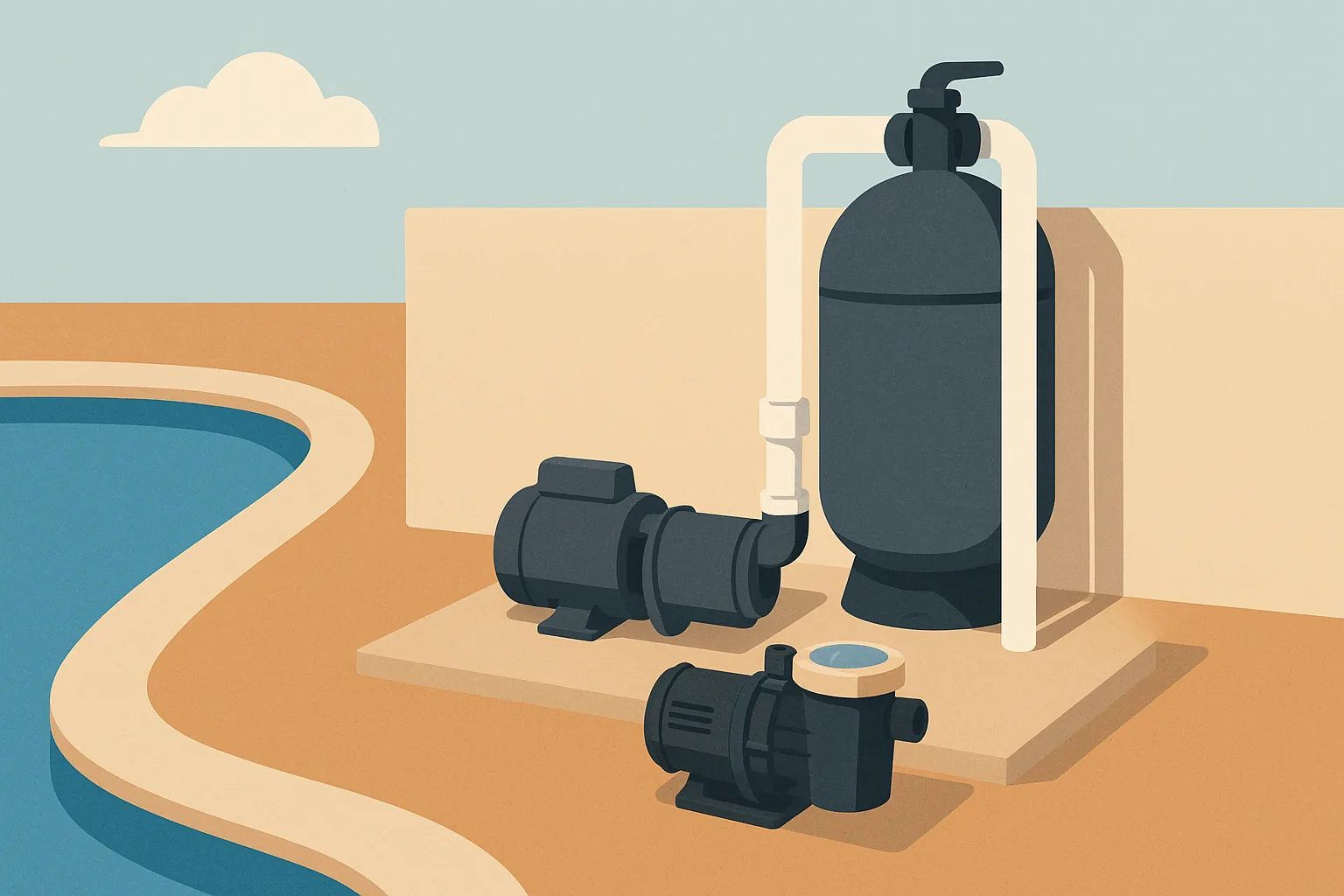
Replacing a pool pump comes down to five moves: match the right pump to your system, cut all power at the breaker, disconnect the plumbing and old wiring, bolt and plumb in the new pump, then re-wire, prime, and test it. The job is within reach for a handy homeowner, but the two places it goes wrong are electrical safety and sizing, so those get the most attention below. If you'd rather not touch the wiring, pool pump replacement in Long Beach covers the sizing, the pump, and the install.
How do I replace a pool pump step by step?
You replace a pool pump by matching a new unit to your system, killing the power, unplumbing and unwiring the old pump, installing the new one, then priming and testing before you walk away. The order matters. Skip the power-off step and you're risking a serious shock; skip the sizing step and you buy the wrong pump twice.
Before you loosen a single fitting, understand what you have. Your pump does one job: it pulls water from the pool, pushes it through the filter, and sends it back clean. If it's humming without moving water, screeching, leaking, or dead silent, it may be the pump, or it may be something you can repair for less. I get into that at the end, because replacing a pump that only needed a forty-dollar capacitor is the most common money-waster I see.
The honest version parts-counter folks won't lead with: this is one of the more DIY-friendly pool jobs, as long as you respect the electricity. The plumbing is forgiving. The wiring is not.
Step 1: Match the right replacement pump
This is the step that saves you the most grief, so do it first, before anything is unplugged. Walk out to your equipment pad and read the label on your existing pump. It lists the horsepower, the voltage (usually 115V or 230V), and the model number. Photograph it. That label is your shopping list.
You're matching three things. First, the flow rate your filter is rated for, because a pump that moves more water than the filter can process actually cleans worse and wastes energy. Second, the plumbing size, so the intake and return line up without a fight. Third, the voltage your electrical supply provides. Bigger is not better here. The goal is a pump that fits the system you already have.
One California-specific note that trips up almost everyone: if you're replacing an old single-speed pump, you almost certainly can't buy another one. California's Title 20 efficiency rules require variable-speed pumps for most residential replacements above a low horsepower threshold. That's a good thing here in Long Beach, where the pump runs most of the year and a variable-speed unit's lower power draw genuinely adds up. Check the current California Energy Commission appliance standards to confirm what qualifies before you buy.
Step 2: Cut the power and confirm it's dead
This is the safety step, and it isn't optional. Go to the breaker panel and shut off the breaker that feeds the pool equipment. If your pump runs on a timer, set the timer to off as well, because a timer clicking on while your hands are in the wiring is exactly the scenario you're avoiding.
Then verify. Don't trust the label on the panel. Use a non-contact voltage tester on the pump's wiring, or simply try to start the pump at the switch and confirm it stays dead. Pool pumps commonly run on 230V, and that's more than enough to seriously hurt you. Treat every wire as live until your tester says otherwise.
While the power's off, close the valves. Shut the skimmer, main drain, and return valves so water doesn't pour out of the plumbing the moment you open the pump. If your pool sits above the equipment pad, this matters even more, because gravity will happily drain your pool through an open fitting.
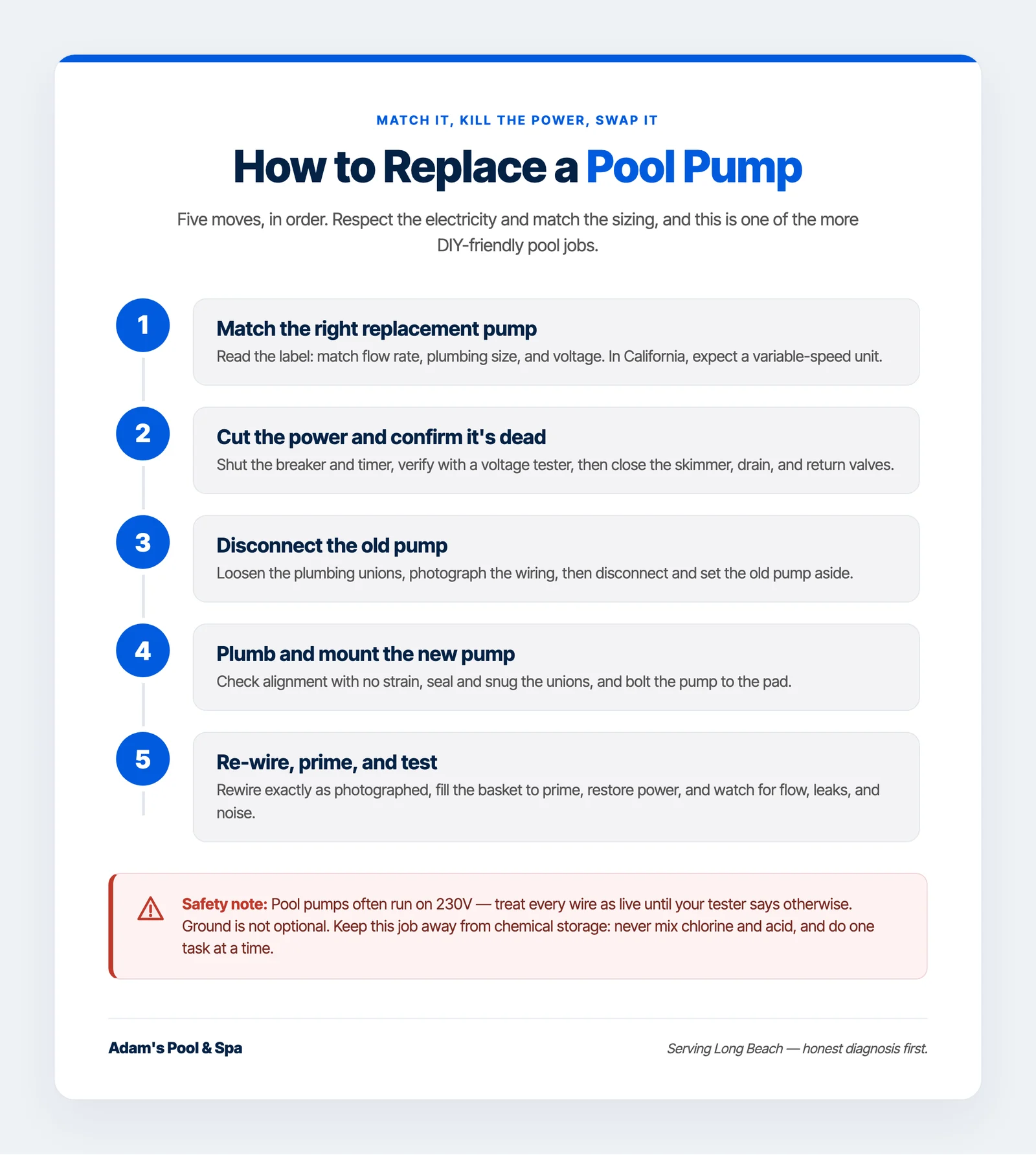
Step 3: Disconnect the old pump
With power confirmed off and valves closed, you can take the old pump out. Most modern pumps connect to the plumbing with threaded unions, which are hand-loosened collars on the intake and return. Turn them counterclockwise and expect a little trapped water to spill. Have a towel and a small bucket ready.
Next, the electrical. Open the wiring compartment on the back of the motor. Before you touch anything, photograph the existing connections so you know exactly where each wire lands on the new pump. Note which wire is line, which is neutral or the second hot leg, and which is ground. Then disconnect them and set the old pump aside.
If your pump is hard-wired through conduit rather than plugged in, and the wiring isn't obvious to you, this is a reasonable place to stop and bring in a licensed electrician. Doing the plumbing yourself and handing off the final connection is a legitimate split. Getting the wiring wrong doesn't just trip a breaker; it can damage a several-hundred-dollar pump on first start.
Step 4: Plumb and mount the new pump
Set the new pump on the pad and check the alignment before you commit. The intake and return ports should line up with your existing plumbing with minimal strain. If the pump sits higher or lower, you may need short lengths of pipe or new fittings to bridge the gap. Never force plumbing into place under tension, because that stress cracks a fitting or a housing months later.
When it lines up, connect the unions. Use fresh Teflon tape on threaded connections and a pool-plumbing sealant if your manufacturer calls for one. Hand-tighten the collars, then give them a modest turn with channel-lock pliers. Snug, not gorilla-tight, since over-torquing cracks the plastic threads. If any joints need gluing, follow the primer-then-cement steps on the can and let the weld cure before running water through it.
Bolt the pump to the pad if your model has mounting feet. A pump left free to vibrate loosens its own plumbing over time, and on the coast that shows up as union leaks a season later.
Step 5: Re-wire, prime, and test
Now reverse the wiring you photographed. Match line, neutral or second hot, and ground exactly as they were on the old pump, following the diagram inside the new pump's wiring compartment. Ground is not optional; it's the wire that protects you if the motor ever faults. If you have any doubt about which wire goes where, stop and get an electrician. This is the single most dangerous point in the job.
Before you restore power, prime the pump. Open the pump lid, fill the basket with water from a hose, reseat the lid and its O-ring, then open the valves you closed in step two. Priming gives the pump water to grab so it doesn't run dry, and a dry-run pump can burn up in minutes.
Restore power at the breaker and start the pump. Watch for three things: water moving through the basket within a minute or two, no leaks at the fittings, and no unusual noise. Once it's primed and circulating, program the variable-speed schedule and check the filter pressure against your normal reading. If anything's dripping, shut it down and re-seat that connection.
The Long Beach angle and a word on chemistry
A couple of local realities make pump work here different from the manufacturer's assumptions. Our pumps run nearly year-round, so they wear faster and the energy math on a variable-speed unit is better than it would be somewhere with a real off-season. Coastal salt air corrodes electrical connections and hardware quicker too, so I check the wiring lugs and mounting bolts closely on any pump within a few blocks of the water.
One safety note that has nothing to do with wiring: keep this job away from your chemical storage. Never handle pool chemicals while you're focused on the pump, never mix chlorine and acid, and ventilate the equipment area if chemicals are stored nearby. Do one task, then the other. Once the new pump is running, retest your water, since a pool that sat with the pump off for a day may need a chemistry check. I walk through that in the why your pool turns green guide.
When should I call a pro instead of doing it myself?
Call a professional, or skip the DIY and call us first, when the pump is hard-wired through conduit and the wiring isn't obvious, when the plumbing needs significant re-piping, when you're switching voltages or adding a variable-speed controller you're unsure how to wire, or when you aren't confident around 230V. Those are the situations where a mistake gets expensive or unsafe fast.
There's also the question of whether you even need a new pump. A bad capacitor, a worn shaft seal, or a failed bearing can often be repaired for far less than a replacement, especially on a pump only a few years old. Before you buy anything, confirm the pump is actually the problem, which is where an honest pool pump repair diagnosis pays for itself. If the failure is part of a larger equipment issue, our pool repair service catches it in the same visit.
I lead with the honest recommendation the same way on every job. If your pump is a repair, I'll tell you it's a repair, and I'll show you the numbers after I've seen it, not before. We don't publish flat pricing, but our pump work comes in around twenty percent under the local Long Beach going rate, and staying on top of it during weekly pool maintenance is what keeps a pump from failing early.
The questions Long Beach pool owners ask us most about replacing a pool pump, answered plainly.
Ready to swap your pump the right way?
You shouldn't have to guess whether your pump needs replacing, which unit is legal to install in California, or whether the wiring is safe to touch, because the wrong guess is expensive at best and dangerous at worst. If your pump has quit or is on its way out, pool pump repair and replacement from Adam's Pool & Spa starts with a straight diagnosis, the right variable-speed pump for your system, and an install done to code. We serve Long Beach and the surrounding neighborhoods, we're Jandy Certified and a Pentair Expert Installer, and we back our work with a twenty-four hour callback guarantee. Call us and we'll start with the honest version.
Adam is the founder, owner, and lead technician of Adam's Pool & Spa, serving Long Beach and surrounding LA County for about fifteen years. He is Jandy Certified and a Pentair Expert Installer, and he built the business on education-first, anti-pressure service, including the "Pool School" session every new client gets.