
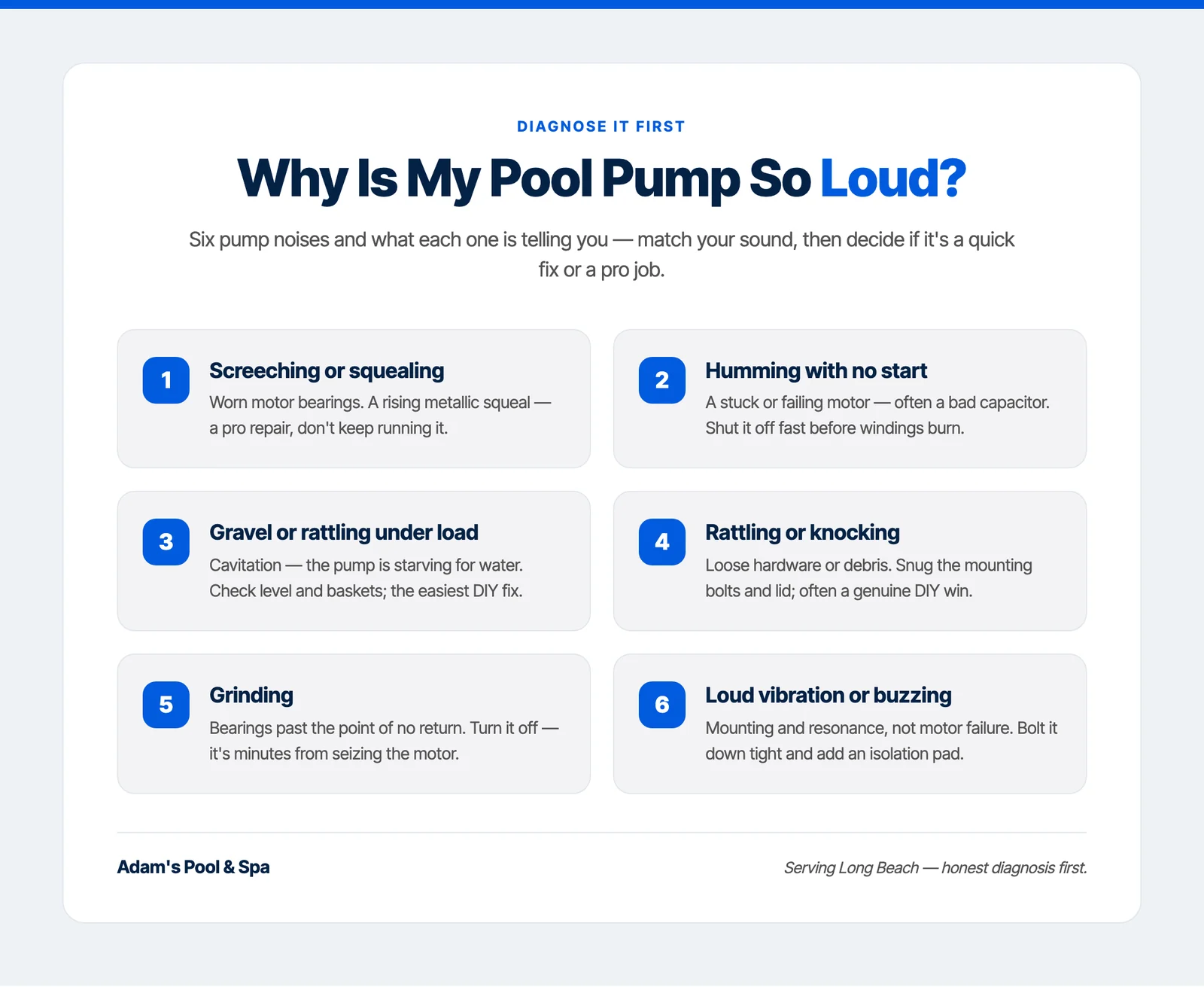
A pool pump gets loud because something is either failing inside the motor or starving the pump of water, and the exact sound tells you which. Worn bearings screech, a seized motor hums, a water-starved pump rattles like gravel, and a loose mount buzzes and vibrates. The fastest way to sort it out is to match your noise to one of the six below, then decide whether it is a basket-and-water-level fix you can do today or a motor job for a pro. If you would rather have it diagnosed properly, pool pump repair in Long Beach starts with finding the real cause before anyone quotes a part.
Why is my pool pump so loud?
Your pool pump is loud because one of two things is wrong: a part inside the motor is wearing out, or the pump cannot get enough water to move. Both make noise, but different noise, and the sound is your best clue. I have listened to a lot of pumps over fifteen years in Long Beach, and you can usually name the problem from the driveway before you open a lid.
Why this matters: some of these noises are a ten-minute fix, and some will cost you a whole motor if you let them run. So the useful question is not "is it loud," it is "which loud." One honest note first: not every loud pump is a broken pump. The sounds that mean trouble are the new ones and the ones that got worse.
The 6 pump noises and what they mean
1. Screeching or squealing: worn motor bearings
This is the classic one, and the most common repair I get called for. A high, metallic screech that rises with the motor means the bearings are worn out. They usually start as a faint hum, get louder over a few weeks, then turn into a screech you can hear across the yard.
Bearings wear from age, heat, and water intrusion past the shaft seal, and our coastal air does not help. The fix is a bearing replacement or, on an older motor, a new motor, since rebuilding a tired unit often costs close to replacing it. This is a pro job, and pressing bearings needs the right tools and a correct seal. Do not keep running it, because a dry bearing can seize and cook the motor.
2. Humming with no start: a stuck or failing motor
If the pump hums but the shaft does not spin, the motor is getting power but cannot turn. The usual suspects are a failed start capacitor, a seized bearing, or debris jamming the impeller. A pump left off all winter often does this on the first spring start.
Shut it off fast. Running a humming, non-spinning motor for more than a few seconds overheats the windings and can destroy it. You can safely check one thing: with the power off at the breaker, clear the pump basket and try to spin the shaft by hand. If it turns freely, the fault is electrical, usually the capacitor, which is a straightforward pro repair. If it will not budge, something is seized and needs a technician.
3. Gravel or rattling under load: cavitation
A sound like the pump is chewing rocks or sucking gravel is cavitation, and it means the pump is starving for water. The impeller is trying to move more water than it can pull in, so air pockets form and collapse inside the housing. Left alone, it slowly chews up the impeller.
The good news is this is the most DIY-friendly noise on the list, because cavitation almost always traces to a flow restriction on the suction side. Work through these in order:
- Check the water level. If it is below the middle of the skimmer, top it off.
- Empty the pump basket and the skimmer basket. A full basket is the number-one cause.
- Look for a closed or half-closed valve on the suction line.
- Check for a sucking sound or bubbles in the pump lid, which points to a suction-side air leak.
If flow is clear and it still rattles, the suction plumbing may be undersized or a valve may be failing, and that is worth a professional look. Our pool filter cleaning also rules out a choked filter starving the whole system.
4. Rattling or knocking: loose hardware and debris
A duller rattle or knock, more like something loose than something grinding, usually is something loose. The motor mounting bolts back out over years of vibration, the lid or a union sits loose, or a pebble made it past the basket into the impeller.
This one is often a genuine DIY win. With the power off at the breaker, snug any loose mounting bolts, confirm the lid and unions are hand-tight, and look for debris around the impeller inlet. If the knock is coming from deep inside the housing where you cannot reach, leave the impeller work to a pro so you do not crack it.
5. Grinding: bearings past the point of no return
Grinding is worse than screeching. Where a squeal says the bearings are wearing, a rough, metal-on-metal churn says they have failed and the shaft is now cutting into metal. Sometimes it is bearings gone fully dry, sometimes the impeller dragging on the housing.
Turn it off and keep it off. A grinding pump is minutes-to-hours from seizing, and every minute adds damage. On a newer pump, this can still be a bearing-and-seal repair. On an older single-speed motor, grinding usually means the motor is done, and this is the moment to price a quieter variable-speed replacement. Either way it is a pro call, not a nurse-it-through-the-weekend call.
6. Loud vibration or buzzing: mounting and resonance
A low buzz or a heavy vibration you feel through the pad more than you hear is usually not the motor failing. It is the pump resonating against its base. A pump not bolted down tight, sitting on a hollow or cracked pad, will hum through the whole equipment area and sound much worse than it is.
Start with the simple checks: confirm the pump is bolted firmly to a solid, level base, and add a rubber isolation pad if it sits on bare concrete. A persistent buzz with no spinning is the humming problem from noise two, so make sure the shaft is actually turning. If it spins fine and the buzz is pure vibration, tightening and isolating the mount often quiets a pump that sounded serious.
How do I quiet a noisy pool pump safely?
Once you know your noise, work the fix in order and know when to shut it off. Running a failing motor is what turns a cheap repair into a new pump.
- Identify the sound first. Screech, hum, gravel, rattle, grind, or buzz. The sound tells you the cause, so do not swap parts blind.
- Kill the power for anything internal. Shut off the breaker before you touch the basket, impeller, or bolts. Water and 240 volts do not forgive.
- Do the free checks. Top off the water, empty both baskets, open any half-closed valves, and snug the mounting bolts.
- Stop running a grind or a stuck hum. These two damage the motor by the minute. Off means off until it is diagnosed.
- Match the age to the fix. Under about eight years with one fault leans toward repair; older and failing in several places leans toward replacement.
- Get a real diagnosis when it is internal. Bearings, seals, capacitors, and impellers need tools and eyes on the equipment.
If the free checks do not quiet it, the problem is inside the motor, and that is the point to bring in a technician rather than keep guessing.
The Long Beach angle: why our pumps wear out faster
A few things about running pool equipment here push pumps toward early noise. Coastal salt air corrodes motor housings and seizes hardware faster than the manufacturer charts assume, so bearings and mounting bolts rarely last as long as the inland average. Year-round swim season is the other factor: our pumps almost never get a winter off, so the run hours pile up and the bearings see more wear per calendar year.
The through-line is that our climate is tough on pumps, so a pump that makes a new noise here deserves a prompt look. Catching a worn bearing early is a small repair; letting it grind into the motor is a replacement.
When should I call a pro instead of tinkering?
Call a professional, or just call us first, when the pump is humming without spinning, screeching or grinding from the bearings, or leaking water from the shaft. Those are internal faults, and every hour you run through them adds motor damage and cost. The free checks are worth doing first, but if they do not land, more tinkering just runs up the bill.
A real diagnosis reads whether the bearings, the seal, the capacitor, or the impeller is the culprit, and tells you honestly whether a repair or a replacement is the smarter money. Adam's Pool & Spa runs pump diagnostics across Long Beach and LA County, and our residential swimming pool pump repair keeps most pools circulating within the same week. We do not publish flat pricing, because the honest number depends on what is actually failing. If the pump is one part of a tired system, our weekly pool maintenance catches the next problem before it gets loud.
The questions Long Beach pool owners ask us most when their pump gets loud, answered plainly.
Loud pump? Let's find out what it's telling you
You should not have to guess whether your pump needs a five-minute basket clean or a new motor, because the wrong guess either wastes a service call or lets a bad bearing cook an expensive motor. If your pump has gotten loud and you are not sure how serious it is, pool pump repair from Adam's Pool & Spa starts with a straight diagnosis of the actual noise, not a shopping list of parts. I am Jandy Certified and a Pentair Expert Installer, and we back our work with a twenty-four hour callback guarantee. Call us and we will tell you what your pump is actually doing first.
Adam is the founder, owner, and lead technician of Adam's Pool & Spa, serving Long Beach and surrounding LA County for about fifteen years. He is Jandy Certified and a Pentair Expert Installer, and he built the business on education-first, anti-pressure service, including the "Pool School" session every new client gets.