
Variable-speed pool pumps are worth it for most Long Beach pools, and the reason is simple physics: slowing a pump down cuts its energy use far faster than it cuts the water it moves. You pay more for the pump upfront, then earn it back through lower electric bills over a few years of normal running. There is also a California angle worth knowing, because Title 20 efficiency rules mean most replacement pumps here are variable-speed anyway. If your current pump is failing or you want the real numbers for your setup, variable-speed pump repair and honest replacement advice in Long Beach starts with your actual pool, not a sales quote.
Are variable-speed pool pumps worth it?
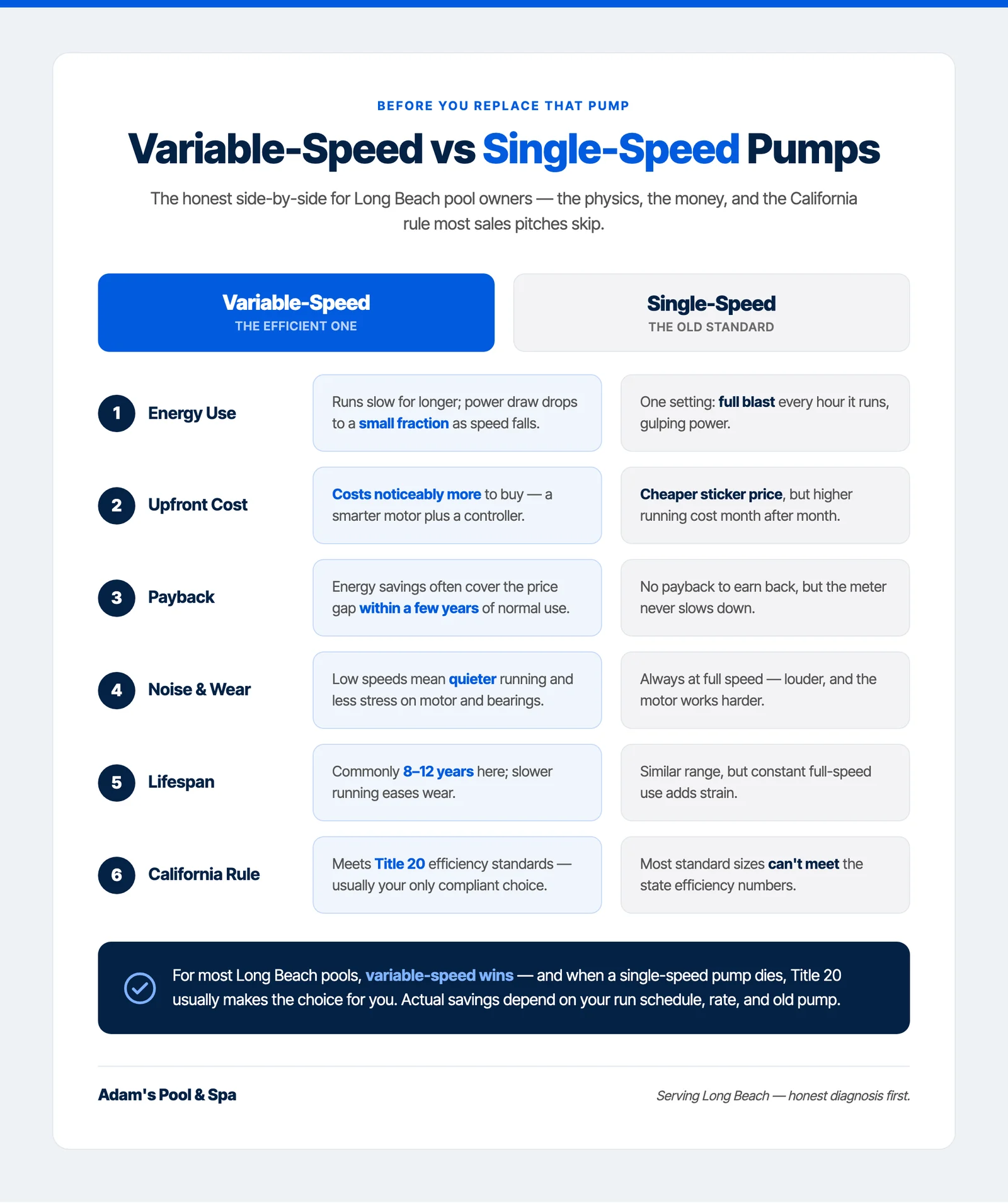
For the great majority of pools I service in Long Beach, yes, a variable-speed pump is worth it. The math works because pump power draw drops much faster than flow when you slow the motor down, so running the pump slow for longer filters the same water while pulling a small fraction of the electricity. That gap between purchase price and running cost is where the savings live.
I'm Adam, and I've been fixing and replacing pool pumps across Long Beach and LA County for about fifteen years. The question I get most from homeowners staring at a dying single-speed pump is whether the pricier variable-speed unit is really worth it, or just another upsell. So here is the honest breakdown, including the parts most sales pitches skip.
The short, truthful version: for a pool that runs any normal schedule, the energy savings usually cover the price difference over time. The exceptions are real but narrow, and I will name them below so you can decide for your own pool rather than take my word for it.
How a variable-speed pump actually saves money
A single-speed pump has one setting: full blast, every hour it runs. A variable-speed pump lets you dial the motor speed up or down, and that is the whole game, because the energy a pump uses climbs steeply with speed. Cut the speed roughly in half and the power draw drops to a small fraction of what it was.
So instead of running a pump hard for a few hours, you run a variable-speed pump gently for longer. You still get at least one full turnover of the water a day, your filtration and skimming still work, but the motor is sipping power instead of gulping it. Longer run time also means better circulation and fewer green-pool problems, which is a real bonus in our climate.
The savings are not evenly distributed, though. The bigger and older your current single-speed pump, and the more hours you run it, the more you stand to save. A representative pattern is that owners of oversized single-speed pumps see the largest drop, while a small pool that barely runs sees the least.
The honest cost breakdown
Here is where I try to be straighter than most pump pitches. A variable-speed pump costs more to buy than a single-speed pump, and that price gap is real. It is not a small rounding difference; you are paying for a smarter motor and a controller. Anyone who tells you it is basically free upfront is glossing over the sticker.
Because I don't publish flat pricing, think about it in three buckets instead:
- Purchase price: a variable-speed pump costs noticeably more than a comparable single-speed unit upfront. The exact figure depends on the brand, the horsepower, and the pool.
- Installation: if you are swapping a failed pump, the labor and plumbing are similar either way. A retrofit motor kit on a sound existing pump can lower this piece.
- Running cost: this is where variable-speed wins back the difference, month after month, through lower pump-related electricity.
The payback period, the time it takes for energy savings to cover the higher purchase price, is what actually decides whether it is worth it for you. For a pool that runs a normal daily schedule, that payback often lands within a few years, and everything after that is money in your pocket. For a pool that runs very little, the payback stretches out and the case gets weaker. I will run that math for your real usage and rate before you commit, using the same honest approach I take with a pool heater repair or replacement decision.
The California reality: Title 20 and why most new pumps are variable-speed
If you are replacing a pump in California, this part matters. State appliance efficiency rules, known as Title 20 and administered by the California Energy Commission, set minimum efficiency standards for pool pumps. A federal dedicated-purpose pool pump standard from the U.S. Department of Energy works alongside them. You can read the state rules on the California Energy Commission's appliance efficiency page.
In plain terms, most standard residential pool pumps sold and installed in California can only meet those efficiency numbers by being variable-speed. Very small pumps below the covered size and certain specialty pumps are handled differently, so this is not a blanket ban on every other pump. But for the typical pool pump replacement, the practical result is that the unit you install will be variable-speed.
I mention this not to alarm anyone, because it is genuinely good news for your electric bill. It just means the choice is often already made for you when a single-speed pump dies, and the useful thing is to understand why the efficient option is worth having rather than feel blindsided by it at the equipment pad.
When a variable-speed pump might not be worth it for you
I would not be doing my job honestly if I pretended it is always the right call. There are a few situations where I tell homeowners to slow down and think it through before spending.
If your pool pump barely runs, on a tiny pool or a spa that only fires up occasionally, the energy savings may be too small to justify the higher purchase price within a reasonable time. The payback math needs enough running hours to work.
If your existing single-speed pump is fairly new and healthy, replacing a working pump purely to chase savings rarely pencils out. It usually makes more sense to keep it until it fails, then replace it with variable-speed then. And on some sound existing pumps, a variable-speed motor retrofit kit can capture much of the benefit for less than a full replacement, which I weigh against the pump's age and condition. When a pump is genuinely on its way out, the symptoms usually show up the same way other pool pump problems do, and a real diagnosis sorts a repair from a replacement.
When should I call a pro instead of guessing?
Call a professional the moment your pump is losing prime, running loud, tripping the breaker, or leaking at the seals, because a pump ties together electrical and plumbing, and guessing wrong is both costly and unsafe. Sizing a variable-speed pump and programming its speeds correctly is also where a lot of the savings are won or lost.
A real assessment does what a spec sheet cannot. It checks whether your current pump is worth keeping, sizes the replacement to your actual pool and plumbing, and programs the run schedule so you get the filtration you need at the lowest power draw. Set it up wrong and a variable-speed pump can run like an expensive single-speed one. If the pump problem is tangled up with the wider pool repair picture, we catch that in the same visit.
We are Jandy Certified and a Pentair Expert Installer, and we back our work with a twenty-four hour callback guarantee. More to the point, we lead with the honest recommendation. If your pump is a repair, we tell you it is a repair.
The questions Long Beach pool owners ask us most about variable-speed pumps, answered plainly.
Thinking about a variable-speed pump? Let's run the real numbers
You should not have to guess whether a variable-speed pump will pay for itself, because the wrong guess costs real money either way. If your pump is failing or you just want the honest math, variable-speed pump repair and replacement from Adam's Pool & Spa starts with your actual pool, your run schedule, and your rate, not a canned savings figure. We serve Long Beach and the surrounding neighborhoods, we are Jandy Certified and a Pentair Expert Installer, and we back our work with a twenty-four hour callback guarantee. Call us and we will start with the honest version.
Adam is the founder, owner, and lead technician of Adam's Pool & Spa, serving Long Beach and surrounding LA County for about fifteen years. He is Jandy Certified and a Pentair Expert Installer, and he built the business on education-first, anti-pressure service, including the "Pool School" session every new client gets.