In this guide
- What are Santa Ana winds doing to your pool?
- Is it safe to begin cleaning that morning?
- What should you clean first after the wind stops?
- Why skim before the debris sinks?
- How do you get the fine dust out of the water?
- Why check the filter pressure after a windstorm?
- How much chlorine should you add after the wind?
- How do you keep up while the wind keeps blowing?
- Want help cleaning up your pool after the wind?
- Frequently asked questions
After Santa Ana winds, start with the baskets, then pull the floating debris before it sinks. Next, brush and vacuum the dust, check your filter pressure, and finish by testing and re-dosing chlorine. Working in that order keeps the pump running safely and stops a messy morning from turning into a week of problems.
I'm Adam, owner and lead technician at Adam's Pool & Spa in Long Beach. After about fifteen years of pool work, the thing I tell owners after a windstorm is that the order matters more than the effort. If you'd rather hand the whole job off, our residential pool cleaning service covers exactly this kind of recovery.
Is it safe to begin cleaning that morning?
Usually, once the wind has actually stopped and you've walked the yard first. Look for broken branches over the equipment pad, damaged fencing, and anything that blew into the electrical area.
If a tree limb or debris is resting on wiring, equipment, or a power line, leave it alone. That is a call to your utility or an electrician, not a pool job. Everything else can wait until you know the area around the pool is clear.
What should you clean first after the wind stops?
Start with the skimmer baskets and the pump basket. A basket packed with leaves blocks the water the pump needs, so flow through the filter drops before you've even begun.
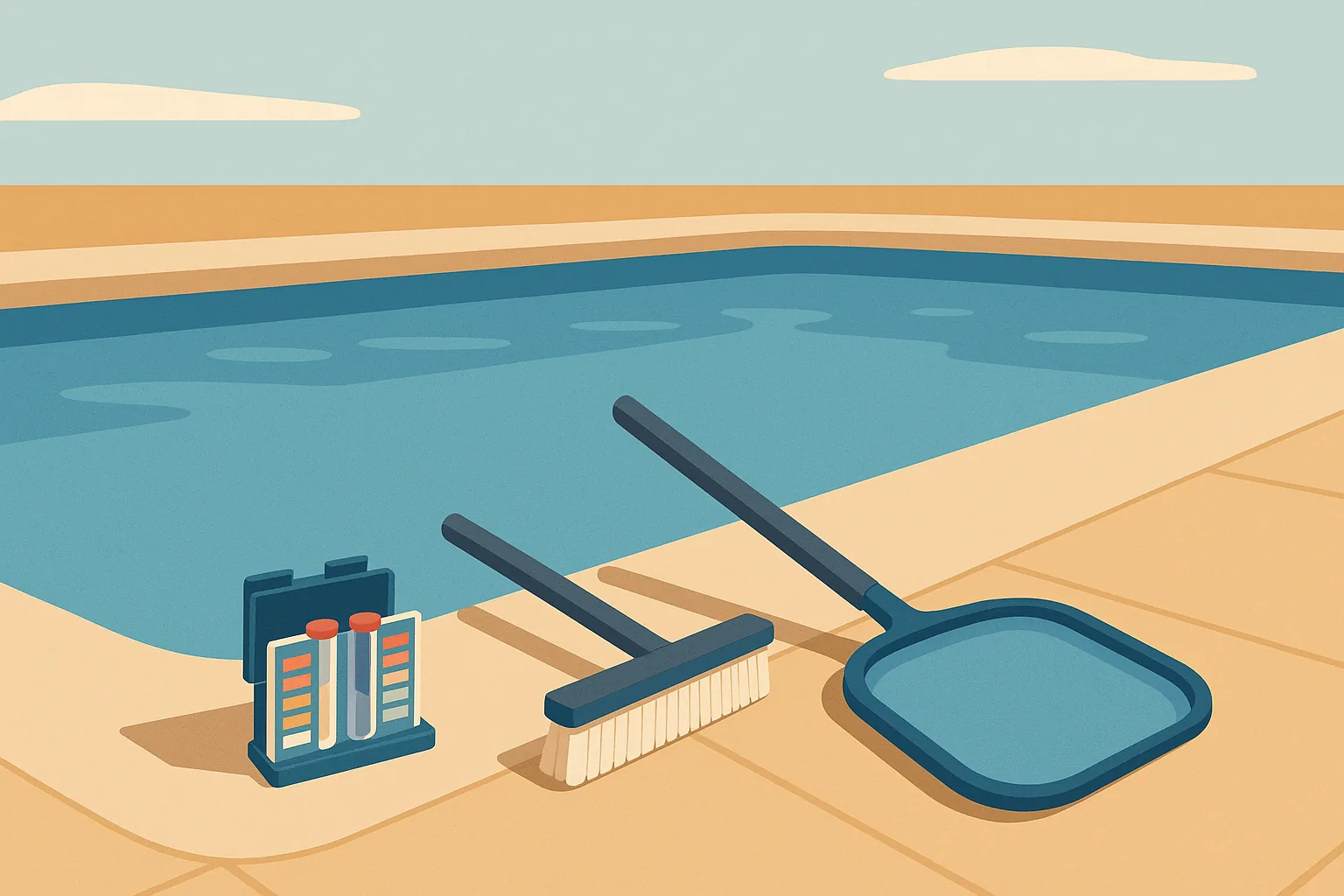
This is the order I follow on a pool after a wind event:
- Turn the pump off before you open the pump basket lid.
- Empty each skimmer basket and the pump basket, then restart the pump.
- Skim the floating leaves off the surface with a leaf net.
- Brush the walls, steps, and floor toward the main drain.
- Vacuum the settled dust and any leaves that already sank.
- Check the filter pressure gauge.
- Test and adjust chlorine and pH.
Empty the baskets again partway through. On a heavy debris day they can fill up more than once while you work.
Why skim before the debris sinks?
Floating leaves are easy to net, and sunk leaves are a vacuum job. Each leaf you catch on the surface is one less you have to pull off the floor.
Use a deep leaf rake rather than a flat skimmer if you have one. It holds far more per pass. Get the surface clear first, then go after the floor once the water has had a little time to settle.
How do you get the fine dust out of the water?
Brush first, then vacuum, then let the filter catch what's left. Dust settles slowly into a film on the floor and steps, and brushing lifts it into the water where the filter can grab it.
If your filter has a waste setting, vacuuming a very heavy dust layer to waste can keep it from loading the filter. Lost water is the tradeoff, so top up the level when you're done. Whichever way you go, don't confuse dust in the water with a chemistry problem. If the water still looks dull after a day of filtering, our guide on why a pool goes cloudy walks through the other causes.
Why check the filter pressure after a windstorm?
Fine debris that slips past the baskets ends up in the filter, and the pressure gauge shows how loaded it is. Compare today's reading to the number you noted after your last filter cleaning.
A reading well above that clean baseline means the filter is full and water flow is dropping. Clean or backwash it before you count on it to clear the water. Our step-by-step guide on how to clean a pool filter covers cartridge, sand, and DE filters.
How much chlorine should you add after the wind?
Add only what your test says you need. CDC guidance on home pool water treatment and testing calls for free chlorine of at least 1 ppm, or at least 2 ppm with stabilizer. The same guidance recommends pH between 7.0 and 7.8.
Test after the debris is out and the pump has run a while. Then dose to bring free chlorine into range and recheck later the same day. Check pH too, because the CDC notes chlorine kills germs less effectively as pH rises, especially above 8.0.
How do you keep up while the wind keeps blowing?
Run short cycles and check the baskets often. ENERGY STAR's guidance on pool pump energy use suggests a timer that runs the pump in several short periods when debris is a problem. Short cycles keep the skimmers pulling debris all day instead of letting it pile up.
A cover helps too, if you have one and it's rated for windy weather. Keep it fastened, since a loose cover in strong wind becomes debris itself.
The questions Long Beach pool owners ask most when the wind dies and the pool is a mess, answered plainly.
Want help cleaning up your pool after the wind?
Some wind events leave more than a homeowner wants to dig out on a weekday morning. At Adam's Pool & Spa, I can empty the equipment, clear the debris, clean the filter, and rebalance the water so it holds. We work across Long Beach and nearby neighborhoods, and we're Jandy Certified and a Pentair Expert Installer. Schedule a visit and I'll begin with what your pool actually needs.
Adam is the founder, owner, and lead technician of Adam's Pool & Spa, working on pools in Long Beach and nearby LA County for about fifteen years. He is Jandy Certified and a Pentair Expert Installer, and he built the business on education-first, anti-pressure service, including the "Pool School" session each new client gets.
Frequently asked questions
Should I turn off my pool pump during Santa Ana winds?
You don't have to. Your pump can keep running through the wind, but check the skimmer and pump baskets as soon as it calms, because a basket packed with leaves starves the pump of water. If debris is heavy, ENERGY STAR suggests a timer that runs several short cycles a day instead of one long block, so the skimmers keep pulling debris all day.
Can I swim in the pool the morning after a windstorm?
Wait until you've cleared the debris and tested the water. CDC guidance for home pools calls for free chlorine of at least 1 ppm, or at least 2 ppm if you use stabilizer, with pH between 7.0 and 7.8. If your test reads outside those numbers, adjust and retest before anyone gets in.
Why is my filter pressure so high after the wind?
Fine dust and plant matter pass the skimmer basket and load the filter, so the pressure gauge climbs above its clean reading. Compare today's number to the reading you noted after the last cleaning. A big jump means the filter is doing its job and needs cleaning before it can keep up.
How long does it take to clean up a pool after a windstorm?
It depends on how much landed in the water and how soon you begin. Light leaf cover can be skimmed, brushed, and tested in a single session. A heavy load of sunk leaves and fine dust can take a couple of rounds of vacuuming, filter cleaning, and retesting before the water is normal again.