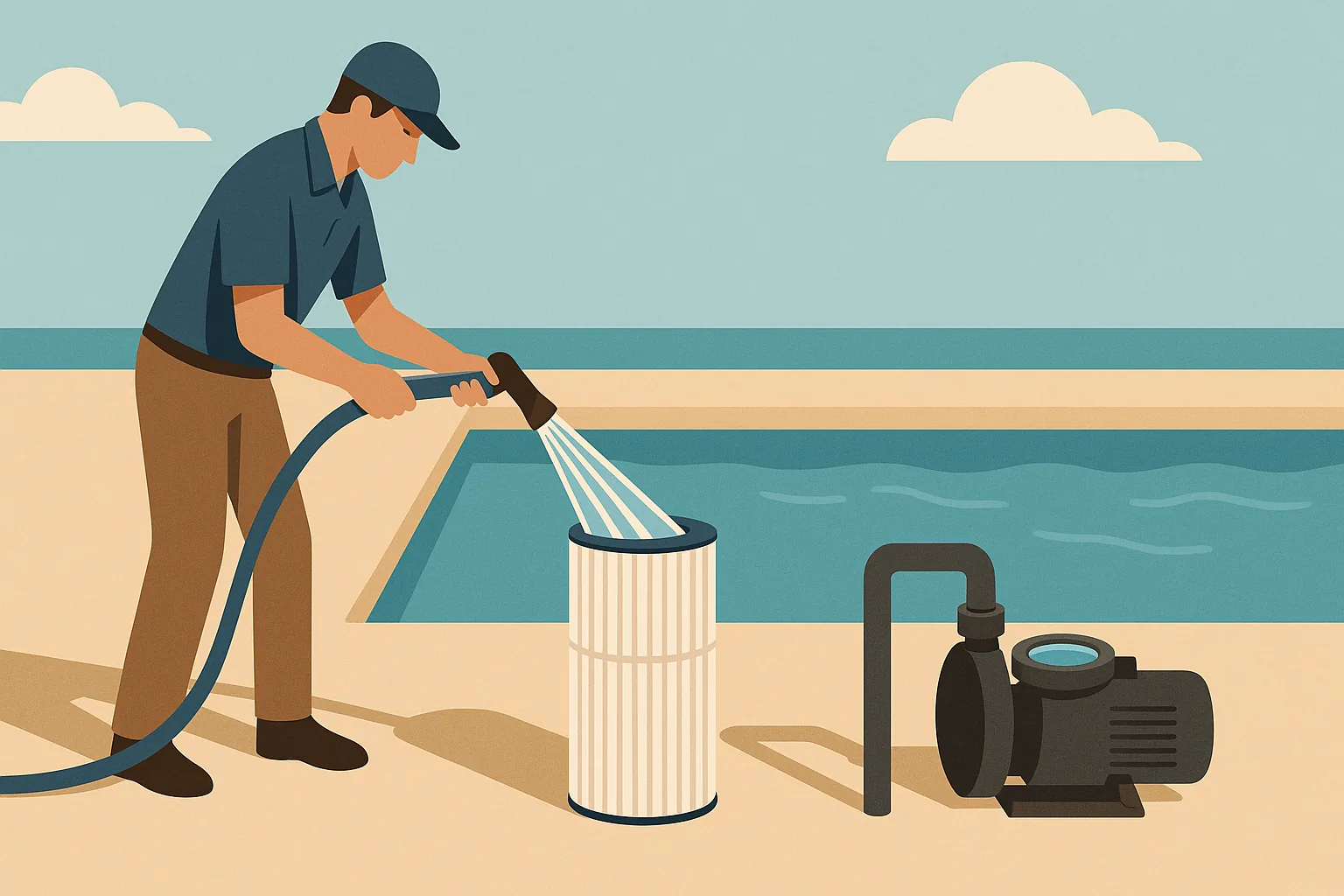
I'm Adam, and I've cleaned Long Beach pools for about fifteen years. When a customer calls because their water won't clear no matter how much they balance the chemistry, the filter is the culprit far more often than the chemicals. So here's exactly how to clean all three filter types in five steps, and how often each one actually needs it. If you'd rather hand it off, residential pool filter cleaning resets your system properly and gets your water moving again.
How do I clean my pool filter?
You clean a pool filter by shutting off the pump, opening the tank, cleaning the media the right way for your filter type, reassembling it, and restarting with the air bled out. The whole job takes twenty to forty-five minutes depending on the filter, and the biggest mistake I see is people cleaning on a calendar instead of watching the pressure gauge that tells them when it's actually due.
First, know which of the three types you have, because the cleaning method is completely different for each. A cartridge filter uses a pleated element you rinse and soak. A sand filter runs water through a bed of sand and cleans by reversing the flow, called backwashing. A DE filter coats a set of grids with diatomaceous earth powder and cleans by backwashing plus recharging. Same five steps, three different middles.
The five steps below work for all three. I'll call out where the method splits by type as we go.
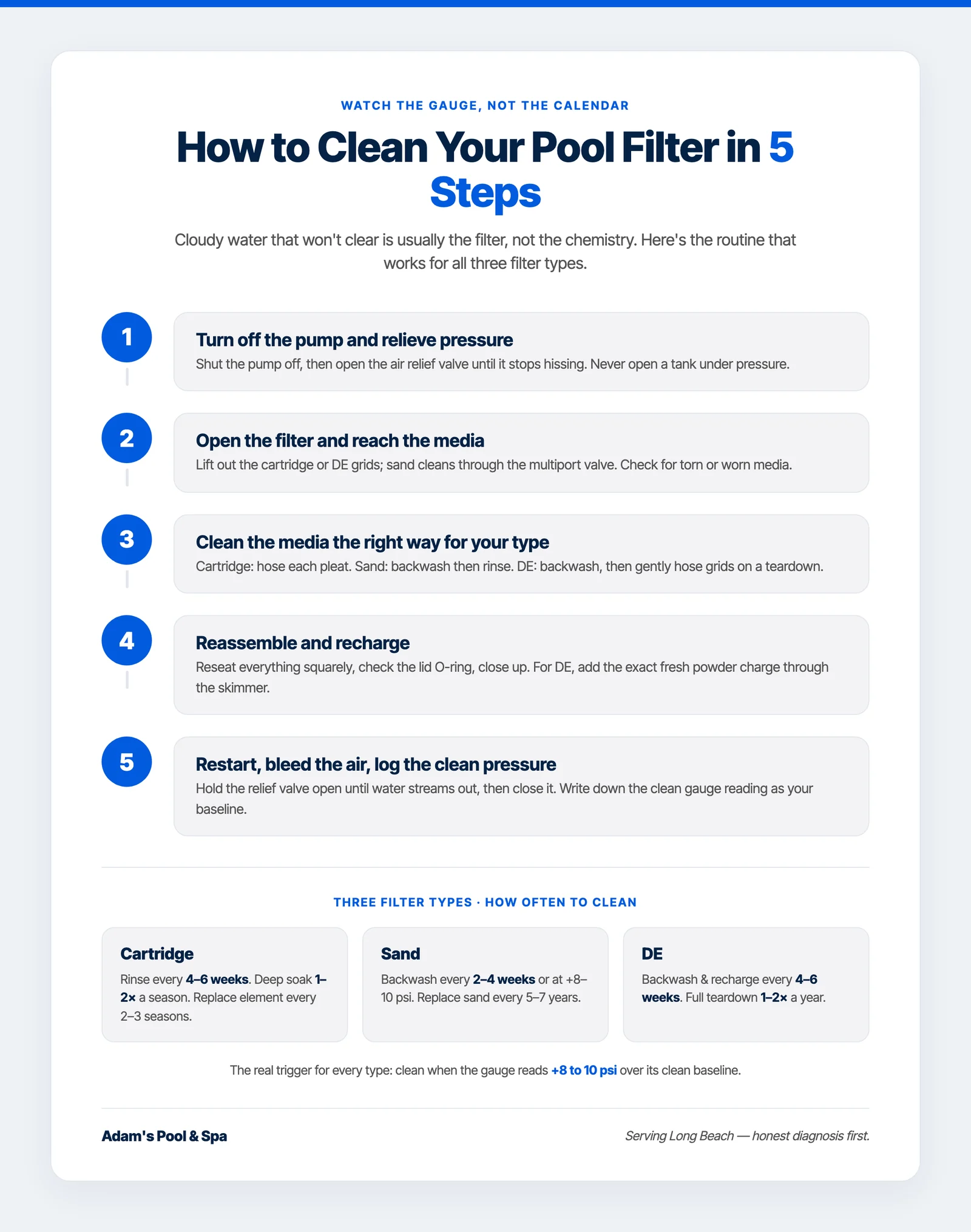
The 5 steps to clean your pool filter
1. Turn off the pump and relieve the pressure
Never open a filter tank under pressure. Turn the pump off at the switch or timer, then open the air relief valve on top of the filter to let out the built-up pressure until it stops hissing. This is a safety step, not an optional one. A tank lid under pressure can lift off hard enough to hurt you.
Once the pressure is fully released, note the starting pressure your gauge read before you shut down. That number is your reference for the next cleaning.
2. Open the filter and get to the media
How you open it depends on your type. On a cartridge filter, remove the clamp band or lid bolts and lift out the pleated cartridge (or cartridges). On a DE filter, open the tank the same way and lift out the grid assembly. On a sand filter, you don't open the tank at all, you'll clean it through the multiport valve in the next step.
Look at the internals while you're in there. Torn pleats, cracked DE grids, or channels worn into the sand bed all mean the media is due for replacement, not just cleaning.
3. Clean the media the right way for your type
This is where the three types split, so match the method to your filter:
- Cartridge: Hose the element from top to bottom, spreading each pleat so the water reaches the base of the folds. For a routine clean this is enough. Once or twice a season, soak it overnight in a filter-cleaner solution to strip out oils and scale the hose can't touch.
- Sand: Set the multiport valve to Backwash, run the pump two to three minutes until the sight glass runs clear, then set it to Rinse for thirty seconds to reseat the sand. Backwashing sends the dirty water to waste, so it uses pool water you'll need to replace.
- DE: Backwash the same way as sand, then hose the grids clean if you've pulled them for a teardown. Never scrub the grid fabric hard or you'll tear it.
4. Reassemble and recharge
Put everything back in the order it came out. Reseat the cartridge or grid assembly squarely, check that the lid O-ring is clean and seated (a dry, cracked O-ring is the top cause of tank leaks), and close the tank.
For a DE filter, this is where you add fresh DE powder back through the skimmer with the pump running, using the exact amount your model calls for. Too little and it won't filter, too much and it clogs or blows back into the pool.
5. Restart, bleed the air, and log the clean pressure
Turn the pump back on and hold the air relief valve open until a steady stream of water comes out, then close it. That bleeds the air out so the pump can prime properly.
Now read the pressure gauge and write that clean number down. When it climbs eight to ten psi above this baseline, the gauge tells you it's time to clean again, so you can trust it over the calendar.
How often should I clean each type of pool filter?
Cartridge filters get rinsed every four to six weeks and a deep chemical soak once or twice a season. That's the general rule, but the real answer for every type is the same: clean when the gauge reads eight to ten psi over its clean baseline, whichever comes first.
Here's how the three types compare in normal Long Beach use:
- Cartridge: Rinse every 4 to 6 weeks. Deep soak 1 to 2 times a season. Replace the element every 2 to 3 seasons.
- Sand: Backwash every 2 to 4 weeks or at +8 to 10 psi. Replace the sand every 5 to 7 years.
- DE: Backwash and recharge every 4 to 6 weeks. Full teardown clean 1 to 2 times a year. Replace grids as they wear.
Our long swim season is why these run shorter here than the manufacturer charts assume. A pool that runs nine or ten months a year with heavy summer use and wind-blown debris simply loads its filter faster than one that closes for winter. If you're recovering from a green pool, expect to clean the filter far more often until the water clears, because it's pulling dead algae out of the water the whole time.
What happens if I never clean my pool filter?
A neglected filter slowly chokes your whole system. As it clogs, water flow drops, so the filter traps less debris and your water turns cloudy even with perfect chemistry. That's the connection most owners miss: filtration and clarity are the same problem, which is also why a dirty filter is a common reason a pool turns green and stays green after shocking.
It gets more expensive from there. A restricted filter forces the pump to work against high pressure, which wears the motor early and drives up your electricity bill. Chlorine also works harder in poorly circulated water, so you spend more on chemicals to get less. A twenty-minute filter clean is one of the cheapest, highest-return things you can do for a pool.
The tell is always the same. If your water won't clear and your chemistry tests fine, stop adding chemicals and check the filter first.
When should I call a pro instead of cleaning it myself?
Routine filter cleaning is genuinely DIY-friendly, and I'd rather teach you to do it than sell you a visit you don't need. Call a pro when the pressure runs high right after a thorough cleaning, which usually means spent media or a deeper flow problem, or when you're facing a full DE teardown and aren't sure of the correct powder charge for your model.
It's also worth a call when you're not sure your filter is even the right size for your pool, or when it clogs again within days of a proper clean. Those point to an equipment or sizing issue that no amount of cleaning fixes. Adam's Pool & Spa handles filter service across Long Beach and LA County, and if the filter turns out to be fine, I'll tell you that instead of finding something to charge for. Ongoing filter care is also part of our weekly pool maintenance, so you never have to track the pressure gauge yourself.
The questions Long Beach pool owners ask us most about cleaning their filters, answered plainly.
Clear water starts with a clean filter
You shouldn't have to guess whether your cloudy water is a chemistry problem or a filter problem, because guessing wrong wastes weeks and money. If your filter is overdue, running high pressure, or facing a teardown you'd rather not tackle, residential pool filter cleaning from Adam's Pool & Spa resets it properly and gets your water moving again. We serve Long Beach and the surrounding neighborhoods, we're Jandy Certified and a Pentair Expert Installer, and we back our work with a twenty-four hour callback guarantee. Call us and we'll get your filter sorted the first time.
Adam is the founder, owner, and lead technician of Adam's Pool & Spa, serving Long Beach and surrounding LA County for about fifteen years. He is Jandy Certified and a Pentair Expert Installer, and he built the business on education-first, anti-pressure service, including the "Pool School" session every new client gets.