You can usually tell your pool is leaking before anyone digs a shovel into the yard, and the signs are hiding in plain sight. Watch for a water level that keeps dropping past normal evaporation, wet or spongy spots on the deck and lawn, cracks in the deck or shell, air bubbles at the return jets, algae or chemistry that will not stay balanced, and a water bill that jumped for no reason. Any one of these can point to a leak. If you would rather have it found and confirmed the right way, pool leak detection in Long Beach uses pressure and dye testing to locate the real source before anyone starts digging.
How can I tell if my pool is leaking?
The clearest sign your pool is leaking is water loss that outpaces normal evaporation, day after day, no matter how often you top it off. In our climate a pool loses roughly a quarter to a half inch a day to sun and heat alone. Lose noticeably more than that on a steady basis, and something is letting water out of the system.
The tricky part is that a leak and plain evaporation look identical at the water line. That is why the six signs below matter: each one is a different piece of evidence, and the more of them you can check off, the more confident you can be that it is a real leak and not just a hot July week.
The honest version I give every customer: most pool leaks are small, findable, and a lot cheaper to fix when you catch them early. You do not need to panic or plan on draining the pool. You need to read the signs, confirm it is actually a leak, and then find the source before anyone tears up your deck guessing.
The 6 warning signs your pool is leaking
1. The water level keeps dropping faster than normal
This is the first and biggest sign. A pool that needs topping off every few days, or that you can watch drop an inch or more a week beyond normal evaporation, is telling you something. Keep a mental note of where the water sits after you fill it, and if it keeps sliding below that mark, take it seriously.
The fastest way to separate a leak from evaporation is the bucket test, and I walk through the whole thing step by step in our guide on why your pool is losing water. The short version: if the pool drops faster than a bucket of water sitting on the step, you have a leak. That one test settles the question before you spend a dime on anything else.
2. Wet or soggy spots around the pool
Water that leaves the pool has to go somewhere, and often it shows up as a patch of ground that stays wet when everything around it is dry. Look for spongy grass, mud that never fully dries, or a section of deck that is damp long after the last splash.
Pay attention to the equipment pad too. A puddle under the pump or filter that keeps coming back points to a leak in the plumbing rather than the shell. Sinking or settling pavers, or a low spot developing in the deck, mean water has been washing out the soil underneath, which is exactly the kind of hidden damage a slow leak causes here in Long Beach.
3. Cracks in the deck, coping, or pool shell
Some cracks are cosmetic, but some are both a cause and a symptom of a leak. A crack in the plaster or a gap where the tile meets the shell can let water out directly. A crack in the surrounding deck or a shift in the coping often means the ground beneath has moved because water has been eroding it.
Run your eye along the waterline tile, the skimmer, and the light niche, since those spots crack and separate more than open plaster does. If you find a crack and the water level parks right at the bottom of it and then holds, that is a strong hint you have found your leak. Hairline surface crazing is usually harmless, but a crack that is holding water back is not.
4. Air bubbles coming from the return jets
Flip this one around from the water-out signs. When you see a steady stream of air bubbles pushing out of the return jets, air is getting sucked into the system on the suction side, and where air gets in, water gets out. It usually points to a leak in the skimmer, a suction line, or a loose fitting at the pump.
You might also notice the pump basket only half full of water, the pump losing prime, or a growling sound as it pulls air. These are plumbing-side leaks rather than shell leaks, and they are common on older systems here. Air in the lines is easy to shrug off, but it is one of the more reliable tells that a suction-side leak is developing.
5. Algae or chemistry you can't keep balanced
A pool that keeps going cloudy or green, or that eats chlorine no matter how faithfully you dose it, can be leaking. Every time the level drops and you add fresh water, you dilute the chemistry and reset the stabilizer, so the sanitizer never gets a chance to hold steady. Constant top-offs quietly sabotage your balance.
If you are fighting the same battle week after week, a leak may be the reason your chemistry never settles. It is worth ruling out before you keep buying chemicals. Our post on why your pool keeps turning green covers the chemistry side, but if the water level is also dropping, a leak is likely feeding the problem from underneath.
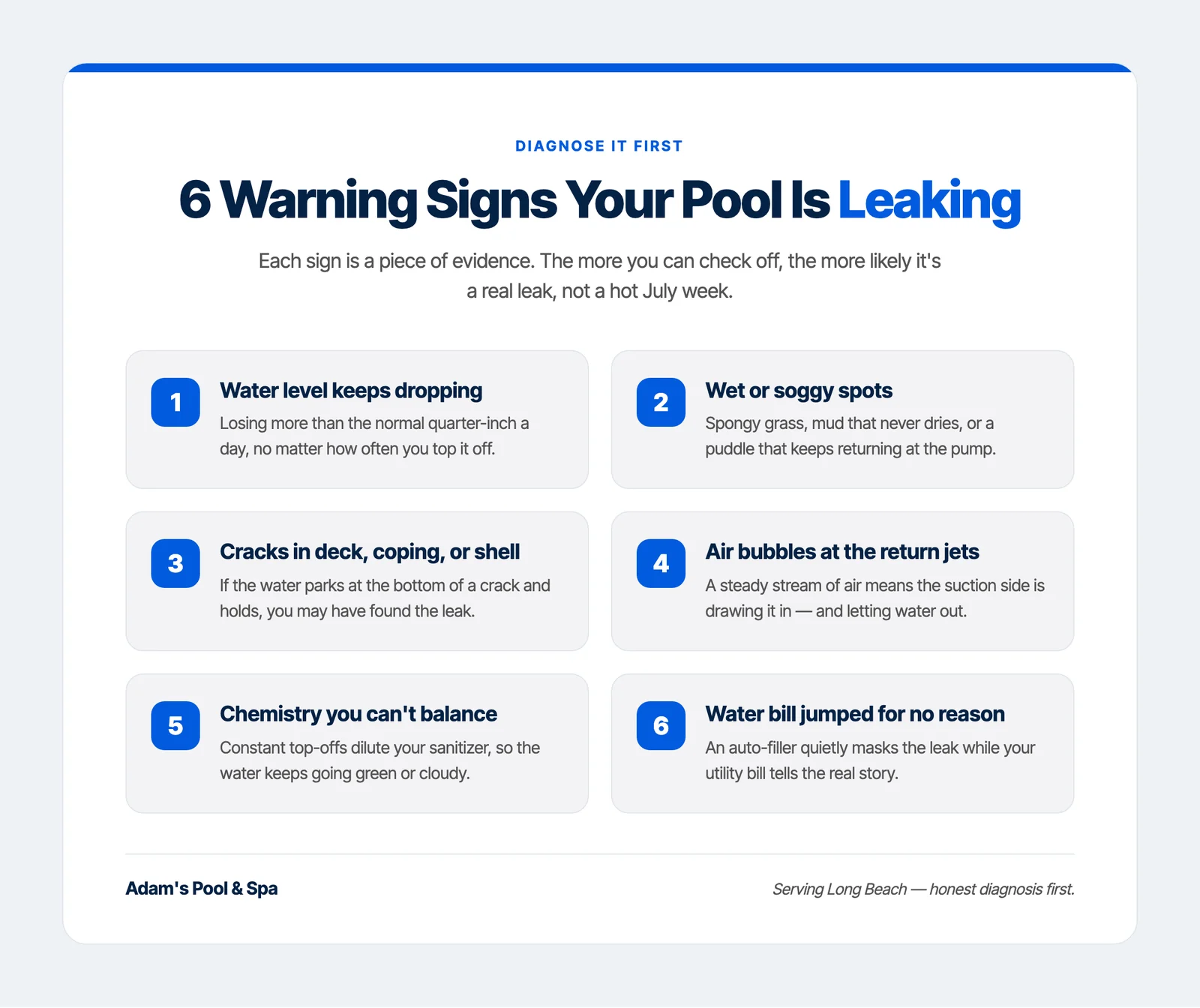
6. A water bill that jumped for no reason
Your utility bill is one of the most honest leak detectors you have. If the bill climbs and you did not change how you water the yard or how much you swim, that extra water is going somewhere, and a leaking pool auto-filler is a common culprit. An auto-fill valve will quietly keep the pool topped off and mask the leak while your bill tells the real story.
Pull up a few months of bills and look for the jump. In Long Beach, where water is expensive and watched closely under state restrictions, a mystery increase is worth a hard look. A leak big enough to move the bill is big enough to be doing damage you cannot see, so treat a sudden spike as a reason to investigate, not ignore.
What to do once you suspect a leak
Once two or three of these signs line up, stop guessing and start confirming. The order matters, because it saves you from digging in the wrong place.
- Run the bucket test. Confirm it is a leak and not evaporation before anything else. This is the free step that saves you money.
- Do a dye test at the obvious spots. With the pump off and the water still, squirt a little test dye near cracks, the skimmer, the light, and the fittings. If the dye gets pulled into a crack, you have found a leak point.
- Watch where the level stops. If the water drops and then holds at a certain height, the leak is near that line. A drop to the skimmer suggests a skimmer or line leak; a drop below the returns suggests the return plumbing.
- Check the equipment pad. Look for drips, wet ground, and air in the pump basket. Plumbing-side leaks often show here first.
- Note whether it leaks with the pump on or off. Leaking only when the pump runs points to pressure-side plumbing; leaking with the pump off points to the shell or suction side.
If those steps do not pin it down, that is the point to call for a real detection service rather than start opening up the deck. Pressure testing the lines and professional dye work find the source without the guesswork, which is the whole reason not to dig first.
The Long Beach angle: why leaks matter more here
A few things about our area make catching a leak early worth the effort. Water is expensive and rationed under state restrictions, so a leak that quietly wastes hundreds of gallons a week hits your wallet and puts you crossways with the rules you are supposed to be following.
Our soil and year-round swim season play a part too. Pools here never get a winter rest, so a slow leak works at the surrounding soil for twelve months straight instead of pausing. Ground that shifts and settles around the shell and deck is a common local problem, and an unfound leak accelerates it. The through-line is that a leak found early is a cheap fitting or reseal, while the same leak ignored becomes the pool leak detection call that comes after the coping has already started to sink.
When should I call a pro instead of chasing it myself?
Call a professional, or just call us first, when the bucket test confirms a leak but the dye test does not show you where, when the water keeps dropping below the skimmer, when you see wet ground or sinking pavers, or when air keeps coming back to the return jets after you have tightened the obvious fittings. Those are the cases where the leak is in the plumbing or under the deck, and no amount of staring at the pool will show it.
A real detection job does what guessing cannot: it pressure tests each line to isolate the leaking one, uses dye and listening equipment to pinpoint the spot, and tells you whether you are looking at a simple fitting reseal or a plumbing repair before anyone breaks concrete. Adam's Pool & Spa runs leak detection across Long Beach and LA County, and I find the source first, then quote the repair, so you are never paying to dig in the wrong place. I do not publish flat pricing, because the fix depends on what the pool is made of and where the leak lands, but you get the real number after I have found it, not before.
The questions Long Beach pool owners ask me most when they think the water is going somewhere it shouldn't, answered plainly.
Think your pool is leaking? Let's find out for sure
You should not have to guess whether your pool is leaking or just drinking up the summer sun, because the wrong guess either wastes water or wastes money on a dig in the wrong spot. If the signs are adding up, pool leak detection from Adam's Pool & Spa starts with confirming the leak and pinpointing the source, not tearing up your deck on a hunch. We serve Long Beach and the surrounding neighborhoods, I am Jandy Certified and a Pentair Expert Installer, and I back the work with a twenty-four hour callback guarantee. Call me and I'll tell you exactly what's going on before anyone picks up a shovel.
Adam is the founder, owner, and lead technician of Adam's Pool & Spa, serving Long Beach and surrounding LA County for about fifteen years. He is Jandy Certified and a Pentair Expert Installer, and he built the business on education-first, anti-pressure service, including the "Pool School" session every new client gets.