A pool that keeps dropping is either leaking or evaporating, and the fastest way to tell them apart is a bucket test over 24 to 48 hours. If the pool loses noticeably more water than a bucket sitting on the step, you have a leak. If they drop about the same, it's evaporation, and Long Beach summer eats more water than most owners expect. Below are four checks that sort it out for good, in order of how easy they are to run. If it does turn out to be a leak, honest pool leak detection in Long Beach pinpoints the source before anyone opens a deck.
Is my pool leaking or just evaporating?
Most pools that seem to be leaking are evaporating. That's the honest starting point, and it saves a lot of owners a service call they didn't need. Water leaves a pool constantly through the surface, faster when it's hot, dry, sunny, and windy, which describes most of our summer. A quarter to half an inch a day is normal, and over a week that reads like a real problem when it isn't one.
The trouble is that evaporation and a slow leak look identical from the deck. You can't eyeball a tile line and know which one you're dealing with, because the daily drop is small and the weather changes it. So the goal isn't to guess, it's to measure the loss against a known baseline and see whether the pool is losing water faster than plain evaporation would explain.
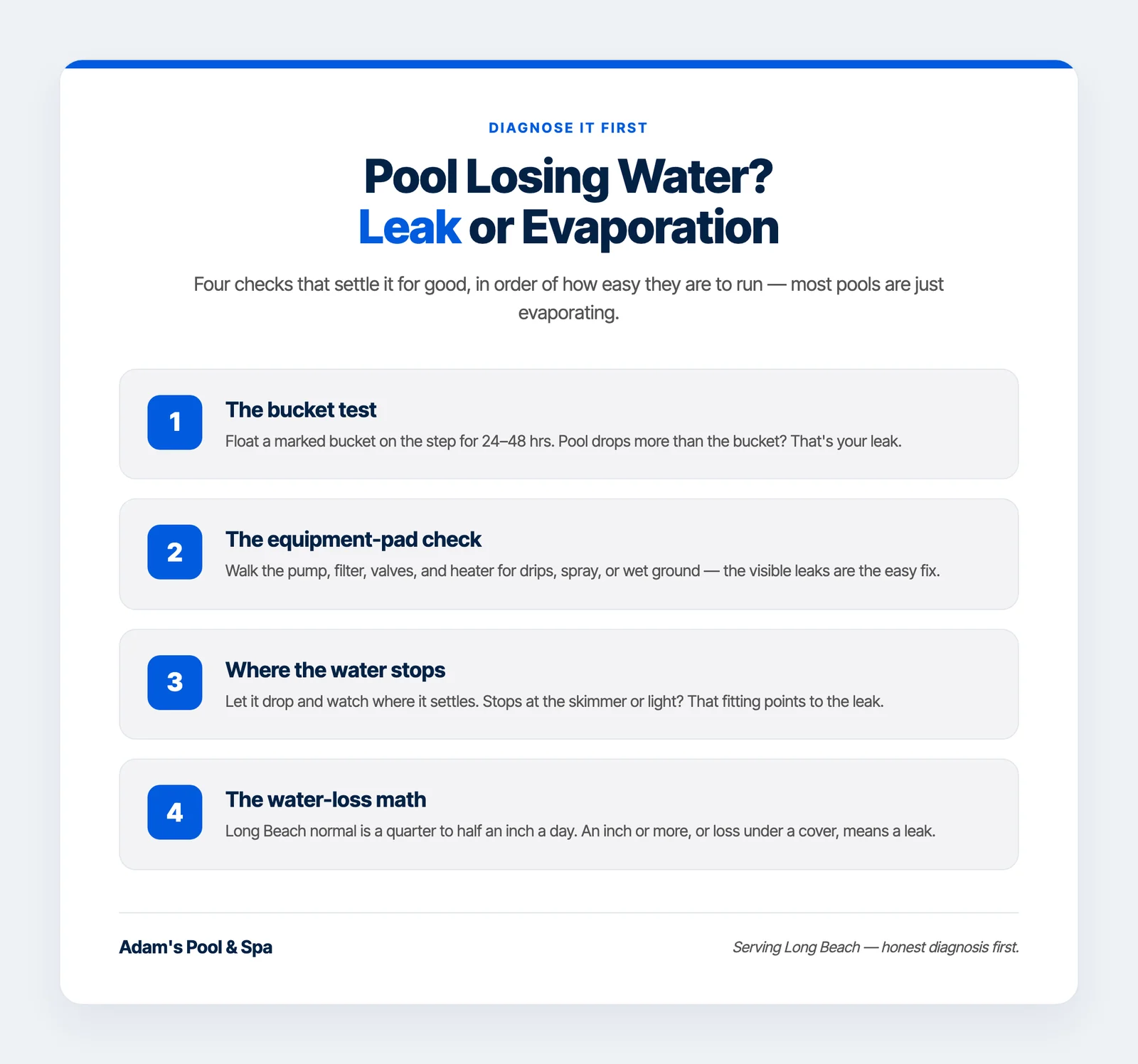
That's what the four tests below do. The first one is the one that settles it, and the other three help you narrow down where the water is going once you know a leak is real.
The 4 ways to tell a leak from evaporation
1. The bucket test (the one that actually settles it)
This is the test that gives you a real answer, and you can run it with a bucket you already own. Fill a five-gallon bucket with pool water and set it on the second step so the bucket is partly submerged. Mark the water level inside the bucket and the pool level outside it, on the same piece of tape if you can.
Now leave it 24 hours, ideally 48, with the pump running as it normally does. Evaporation pulls water from the bucket and the pool at the same rate, because they're the same water in the same weather. So if both levels drop the same amount, you're evaporating and there's no leak. If the pool dropped more than the bucket, the difference is your leak.
Run it a second time with the pump off if you want to narrow it further. A leak that only shows up with the pump running usually sits on the pressure side of the plumbing, and a leak that shows up either way is more likely structural.
2. The equipment-pad and plumbing check
The easiest leaks to find are the ones you can see, so walk the equipment pad before you assume the loss is underground. Look at the pump, the filter, the valves, and the heater while the system is running, and check for drips, spray, or a puddle that keeps coming back after you dry it.
Pay attention to the ground around and under the pad. Soil that stays wet or muddy when everything else is dry, or a small channel of erosion running away from the pipes, is a strong sign of a plumbing leak feeding water into the ground. A leak here wastes water every hour the pump runs, which is why a pool can seem to drop fast even though nothing looks dramatic.
If you find a wet fitting or a weeping valve, that may be your whole answer. Equipment-pad leaks are the good kind, because they're visible and the fix rarely means digging.
3. Where the water stops dropping
The level a leaking pool settles at is a clue in itself, so let it drop and watch where it stabilizes. Water will fall until it reaches the height of the hole, then stop, because below that point there's nothing left to push it out. That resting line points you at the leak.
If the water stops at the skimmer, the leak is likely at the skimmer throat or its plumbing, which is one of the most common spots we find. If it stops at a light, suspect the light-fitting gasket or the conduit behind it. If it keeps dropping well below every fitting, you're probably looking at a structural crack in the shell or the main drain line.
Don't let it drop for days on end, though. Running a plaster or fiberglass pool low in summer heat stresses the shell and can float a fiberglass pool, so use this as a reading, not a long experiment.
4. The water-loss math
Numbers beat guessing, so do a little arithmetic before you call anyone. Measure how much the pool drops in a full day with a ruler or a piece of tape on the tile, and compare it to normal evaporation. In Long Beach summer, normal is roughly a quarter to half an inch a day, and a brutal, dry, windy day can reach three quarters of an inch.
If you're losing an inch or more a day, or the loss holds steady when the weather cools off and you throw a cover on, that's a leak, not evaporation. A cover is a useful cross-check here: it cuts evaporation dramatically, so if a covered pool keeps dropping, the water is leaving through a hole, not the surface.
One honest caveat. Every pool and every week is different, and these ranges are representative, not a guarantee for your exact pool. The math tells you whether to worry, and the bucket test confirms it. If both point at a leak, the next step is finding exactly where, which is where the guessing needs to stop.
The Long Beach angle: why our pools lose more water
Our climate skews the whole evaporation picture, which is why so many local owners think they have a leak when they don't. We get long, hot, dry stretches with real wind coming off the water, and wind is the biggest evaporation driver most people forget about. A breezy 90-degree afternoon can pull water off a pool surface far faster than a still, humid day at the same temperature.
Year-round swim season adds to it. Our pools rarely sit covered and unused the way a pool in a cold climate does, so they're evaporating and getting splashed out twelve months a year. Heaters make it worse, because warm water evaporates faster, and a heated spa attached to a pool can drop surprisingly fast on a cool evening.
None of that is a leak. It's why the bucket test matters so much here, and why I'd rather you measure before you pay anyone, including us. If the numbers do come back pointing at a real leak, our pool leak detection work isolates the plumbing from the shell so we find the actual source instead of digging on a hunch.
When should I call a pro for a pool leak?
Call for a leak detection when the bucket test clearly shows the pool losing more than the bucket, when a covered pool keeps dropping, or when you see wet or eroding ground near the pad or the pool that won't dry out. Those are the cases where the water is leaving through a hole, and finding it is a job for pressure tests, dye tests, and listening equipment, not more guessing.
The reason to bring in help is precision. A real diagnosis isolates the shell from the plumbing, pinpoints the exact spot, and tells you whether you're looking at a simple fitting reseal or an underground pipe, which is the difference between a small pool leak repair and a big dig. Adam's Pool & Spa serves Long Beach and the surrounding LA County neighborhoods, and we find the source first so the repair matches the actual problem. We don't publish flat pricing, because leak work depends on the source, the depth, and access, and you get the real number after we've found the leak, not before.
The questions Long Beach pool owners ask us most when the water line keeps dropping, answered plainly.
Losing water? Let's find out why before you spend a dime
You shouldn't have to guess whether your pool is leaking or just evaporating, because the wrong guess either wastes money on a service call you didn't need or lets a real leak run for months. Run the bucket test first. If it points at a leak, pool leak detection from Adam's Pool & Spa pinpoints the exact source before any deck or plumbing gets opened up. We serve Long Beach and the surrounding neighborhoods, we're Jandy Certified and a Pentair Expert Installer, and we back our work with a twenty-four hour callback guarantee. Call us and we'll tell you what you're actually dealing with first.
Adam is the founder, owner, and lead technician of Adam's Pool & Spa, serving Long Beach and surrounding LA County for about fifteen years. He is Jandy Certified and a Pentair Expert Installer, and he personally runs the diagnostic on every leak detection call, isolating the shell from the plumbing before anyone opens a deck.