In this guide
- What size pool heater do you need?
- How to size a pool heater in 4 steps
- What does the "times 12" assume?
- How long will it take to heat your pool?
- Does a gas heater or heat pump change the size?
- How much does a pool cover help?
- Signs your current heater is the wrong size
- Want help sizing your next pool heater?
- Frequently asked questions
To size a pool heater, multiply your pool's surface area in square feet by the temperature rise you want, then by 12. That gives the BTU per hour output you need, using a U.S. Department of Energy formula. A 15 by 30 foot pool needing a 20 degree rise needs about 108,000 BTU per hour. Wind, a cover, and the heater type adjust that number up or down.
I'm Adam, owner and lead technician at Adam's Pool & Spa in Long Beach. I'm Jandy Certified and a Pentair Expert Installer, and I've installed and repaired heaters on pools all over the area. Most heater regrets I see come from sizing, not brand. This is how to get the number right before you choose between gas and electric pool heaters.
How to size a pool heater in 4 steps
This is the DOE method, worked for a typical backyard pool.
- Pick your target water temperature. Many owners land in the low 80s. Our example uses 82 degrees.
- Find the average air temperature for your coolest swim month. Our example assumes 62 degrees.
- Subtract to get the temperature rise. 82 minus 62 is a 20 degree rise.
- Multiply area by rise by 12. A 15 by 30 foot pool is 450 square feet. 450 times 20 times 12 is 108,000 BTU per hour.
Those example temperatures are placeholders, not a forecast. Use your own target and the month you actually plan to swim. Pushing your season into December raises the rise, and the heater size with it.
What does the "times 12" assume?
It assumes a modest heat-up rate and light wind. The DOE page bases the formula on a rise of 1 to 1.25 degrees F per hour. It also assumes a 3.5 mile per hour average wind.
For faster heat-up, the page says to multiply by 1.5 for 1.5 degrees per hour. Use 2.0 for 2 degrees per hour. A breezy yard needs more capacity too. Santa Ana wind days and an open lot both pull heat off the water faster than the formula expects.
How long will it take to heat your pool?
Work it out from your gallons and the heater's output. One BTU raises one pound of water by one degree F, and a gallon of water weighs about 8.34 pounds.
Here's the math on a 20,000 gallon pool:
- Find the BTUs needed. 20,000 gallons times 8.34 times a 10 degree rise is about 1,668,000 BTUs.
- Divide by heater output. At 125,000 BTU per hour, that's about 13 hours.
- Add time for losses. Wind, evaporation, and cool nights stretch that, so treat it as a best case.
This is why the first heat-up after a cold week takes a day or more. Holding a temperature takes far less than raising it.
Does a gas heater or heat pump change the size?
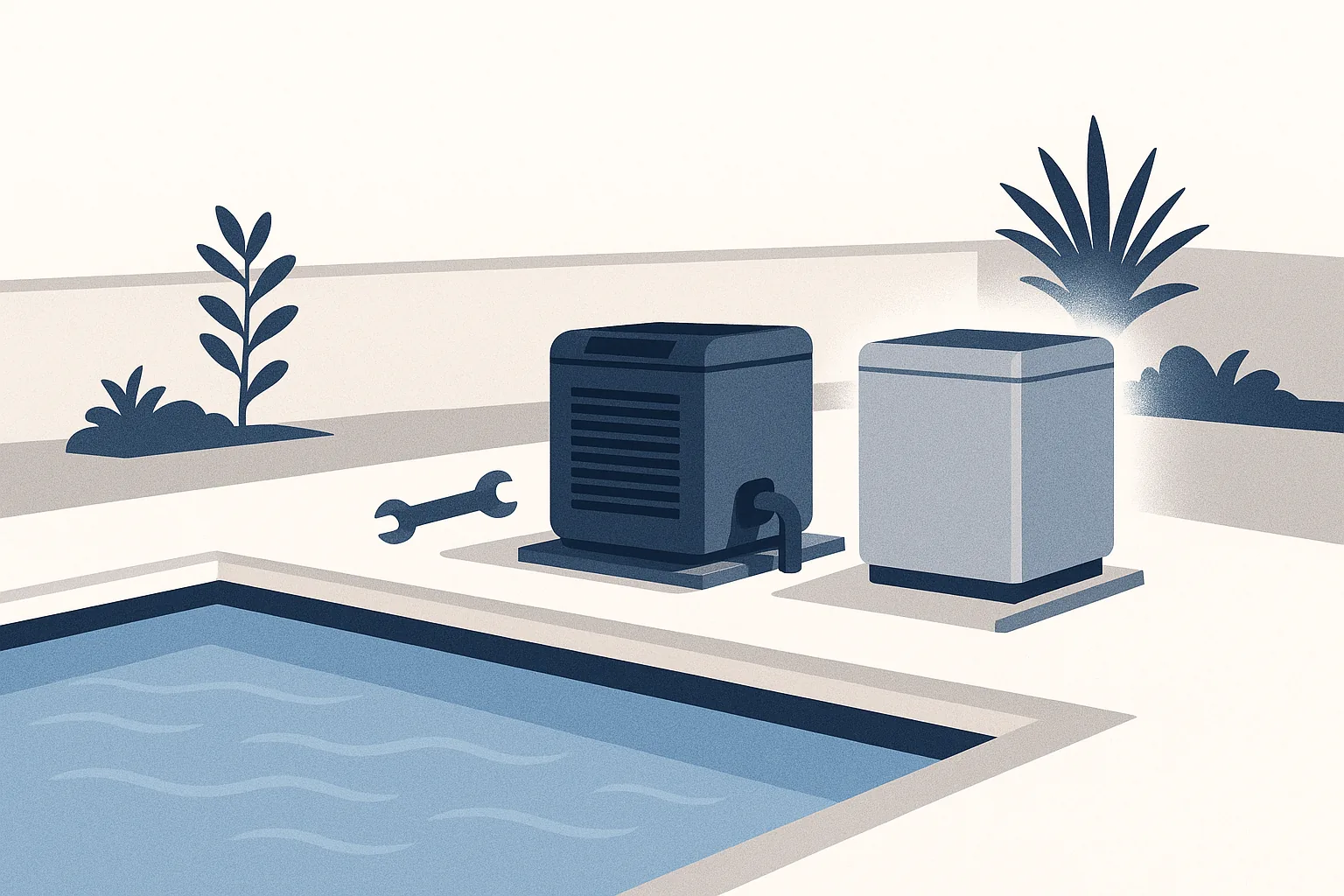
The formula stays the same, but the two types behave differently. Heat pumps are rated in BTU output and horsepower. The DOE page lists standard sizes of 75,000, 100,000, and 125,000 BTU.
A heat pump moves heat from the air into the water, so its output drops as the air cools. The DOE page says heat pump efficiency ratings, called COP, usually run from 3.0 to 7.0, tested at 80 degree air. Check the maker's chart for output at cooler air temperatures before you buy.
Gas heaters are usually labeled by input BTU, and some of that heat goes up the vent. Compare the output figure, or input times the rated efficiency, against your sizing number. For a spa you heat on demand, gas usually wins on speed.
How much does a pool cover help?
A lot, because most heat leaves through the water surface. The same archived DOE page estimates a May to October Los Angeles heat pump season for a 1,000 square foot pool at 78 degrees. It lists $1,294 without a cover and $116 with one.
Those are federal estimates from an older table, not a quote for your pool. The gap is the point. A cover can let a right-sized heater hold temperature on far less energy. Our post on what a new pool heater does to your energy bill covers running costs in more detail.
Signs your current heater is the wrong size
An undersized heater runs for hours and never reaches the setpoint. An oversized one heats fast but costs more to buy and install than you needed. Watch for these:
- The pool never reaches temperature on cool evenings
- The heater runs most of the day just to hold temperature
- A heat pump struggles once the air drops in winter
- The spa takes far longer to heat than it should
Some of those point to sizing. Others point to a fault, like a scaled heat exchanger, a weak pump, or a failing sensor. Before you replace anything, have a tech rule out a repair. Our pool heater repair service starts with that check.
The questions Long Beach pool owners ask most about pool heater size, answered plainly.
Want help sizing your next pool heater?
The right heater comes from your pool's numbers, not a guess at the store. At Adam's Pool & Spa, we measure the surface area and talk through when you swim. Then we match a gas heater or heat pump to that. We work across Long Beach and nearby neighborhoods, and we're Jandy Certified and a Pentair Expert Installer. Schedule a visit and we'll run the math with you.
Adam is the founder, owner, and lead technician of Adam's Pool & Spa, working on pools in Long Beach and nearby LA County for about fifteen years. He is Jandy Certified and a Pentair Expert Installer, and he built the business on education-first, anti-pressure service, including the "Pool School" session each new client gets.
Frequently asked questions
What size pool heater do I need?
Multiply your pool's surface area in square feet by the temperature rise you want, then by 12. That gives the BTU per hour output a U.S. Department of Energy guide uses for sizing. A 450 square foot pool needing a 20 degree rise comes out near 108,000 BTU per hour.
Is a bigger pool heater better?
Up to a point. A larger heater warms the pool faster and copes better with wind and cool nights. Past what your pool needs, you pay more up front for capacity you rarely use. Size for your pool and how you swim, then step up one size for a windy yard.
How long does it take to heat a pool?
It depends on the gallons, the temperature rise, and the heater's output. One BTU raises one pound of water by one degree F, and a gallon of water weighs about 8.34 pounds. Divide the BTUs needed by the heater's output per hour, then allow extra time for heat lost to the air.
Do I size a heat pump the same way as a gas heater?
The starting math is the same: surface area times temperature rise times 12. Heat pumps lose output as the air cools, though. Check the maker's rating near your coolest swim month, not just the headline number.
Does a pool cover change what size heater I need?
It changes how hard the heater works. A cover stops a lot of the heat loss from the water surface, especially overnight. With a cover, a right-sized heater holds temperature on less fuel or electricity.