
Deciding between pool heater repair and replacement comes down to four things: the age of the unit, the cost of the fix, how often it has been breaking down, and how efficiently it still runs. If your heater is under about eight years old and has one clear fault, pool heater repair in Long Beach is usually the smart, cheaper call; if it is a decade old and failing in more than one place, replacement often makes more sense.

Should I repair or replace my pool heater?
The quickest way to frame the decision is to ask whether you are dealing with a single, fixable fault or a unit that is wearing out all over. A heater that suddenly stops firing, throws one error code, or has a bad igniter is usually a repair. A heater that has needed two or three visits in the same season, shows corrosion on the heat exchanger, and is well past its expected lifespan is usually a replacement.
Think of it the way you would an older car. One repair on an otherwise sound vehicle is worth doing. But when the fixes start stacking up and the whole thing is tired, you are throwing good money after bad. Pool heaters follow the same logic, and the four factors below are how we sort one situation from the other.
The honest answer is that most heaters we look at in Long Beach are repairs, not replacements. Companies that lead with "you need a new one" before they have diagnosed anything are usually selling, not helping. That is not how we work.
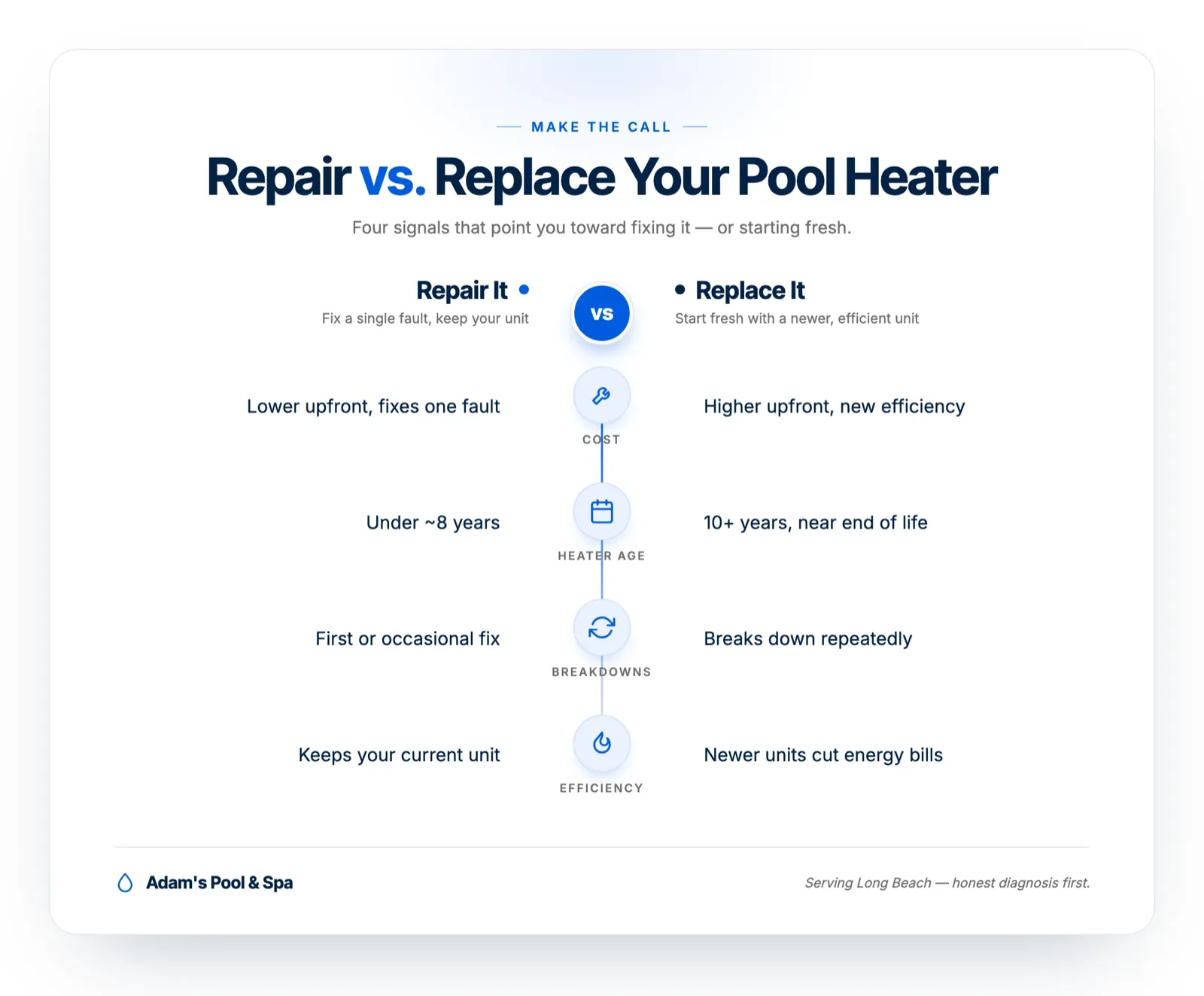
What does pool heater repair cost versus a new heater?
Repair costs less upfront because you are paying to fix one thing, not to buy and install an entirely new system. A typical repair addresses a specific failed component, while a replacement means the price of the new unit plus the labor, plumbing, gas, and electrical work to install it. That gap is real, and it is why repair is the default answer whenever the heater has life left in it.
Because we do not publish flat pricing, here is how to think about it instead. A standard repair diagnostic in the Long Beach market tends to run in the range of a typical contractor visit, and Adam's Pool & Spa comes in around twenty percent under the local going rate. A full heater replacement is a much larger number, since you are buying the equipment itself. We give you the actual figures after we have seen the heater, not before.
The trap to avoid is spending repair money three times on a heater that was always going to need replacing. A good diagnosis prevents that. When we look at your unit, we tell you whether the repair is a real fix or just a bandage on a failing system, so you are not paying twice.
How old is too old for a pool heater?
Age is the single clearest signal. A gas pool heater in our climate commonly lasts around eight to twelve years, and heat pumps often stretch a bit longer, so the rough dividing line looks like this:
- Under about 8 years old: repair is almost always the right call. The unit has plenty of service life ahead, and one fault does not change that.
- 8 to 10 years old: it depends on the fault and the heater's history. A minor repair still makes sense; a major internal failure starts to tip toward replacement.
- 10 or more years old: replacement deserves a serious look, especially if the heater is failing in more than one spot or the repair is expensive.
Long Beach adds a wrinkle. Salt air near the coast and hard water inland both age heaters faster than the manufacturer's estimate assumes. A ten-year-old heater a few blocks from the water may be more worn than its age suggests, which is something we factor into the recommendation rather than reading the number off a chart. This is the same wear pattern we watch for during weekly pool maintenance, where catching scale and corrosion early is what keeps a heater from dying young.
Does replacing my pool heater actually save on energy bills?
It can, and this is the one factor that sometimes justifies replacing a heater that still technically works. Heater efficiency has improved noticeably over the last decade, so a modern unit uses less gas or electricity to bring your pool to the same temperature. If you heat your pool often, an old, inefficient heater can quietly cost you more in energy every month than you would expect.
Repair keeps your current unit and its current efficiency. That is fine when the heater is reasonably modern and runs well. But if you are nursing along a fifteen-year-old heater that was never very efficient to begin with, the monthly energy waste is part of the true cost of keeping it, even before the next repair bill. The choice between a new gas heater and a heat pump also affects your running costs, and we walk through that in our gas vs. electric pool heater guide.
The honest version is that efficiency alone rarely justifies replacing a young, healthy heater. It becomes a real factor when age, repeated breakdowns, and energy waste all point the same direction. When they do, a new heater can pay part of itself back over time. We will show you that math for your actual usage rather than promising savings that may not materialize.
When should I call a pro instead of guessing?
Call a professional the moment your heater stops holding temperature, throws an error code you do not recognize, or fails to fire at all, because pool heaters combine gas, electrical, and plumbing in one box, and guessing wrong is both expensive and unsafe. This is not a component you want to troubleshoot by swapping parts and hoping.
A real diagnosis does three things a phone estimate cannot. It confirms the actual fault instead of the assumed one. It checks whether the problem is isolated or a sign the whole unit is going. And it gives you a repair-or-replace recommendation grounded in what the technician is actually looking at. If the bigger pool repair picture involves more than the heater, we catch that in the same visit.
We are Jandy Certified and a Pentair Expert Installer, and we back our work with a twenty-four hour callback guarantee, so you are not left waiting on a cold pool. More to the point, we lead with the honest recommendation. If your heater is a repair, we tell you it is a repair.
The questions Long Beach pool owners ask us most about repairing or replacing a heater, answered plainly.
Not sure which way to go? Let's diagnose it honestly
You should not have to guess whether your heater is worth fixing. If it is struggling, short-cycling, or just not heating the way it used to, pool heater repair and replacement from Adam's Pool & Spa starts with a straight diagnosis and an honest recommendation, not a sales pitch for a new unit. We serve Long Beach and the surrounding neighborhoods, we are Jandy Certified and a Pentair Expert Installer, and we back our work with a twenty-four hour callback guarantee. Call us and we will start with the honest version.
Adam is the founder, owner, and lead technician of Adam's Pool & Spa, serving Long Beach and surrounding LA County for about fifteen years. He is Jandy Certified and a Pentair Expert Installer, and he built the business on education-first, anti-pressure service, including the "Pool School" session every new client gets.