
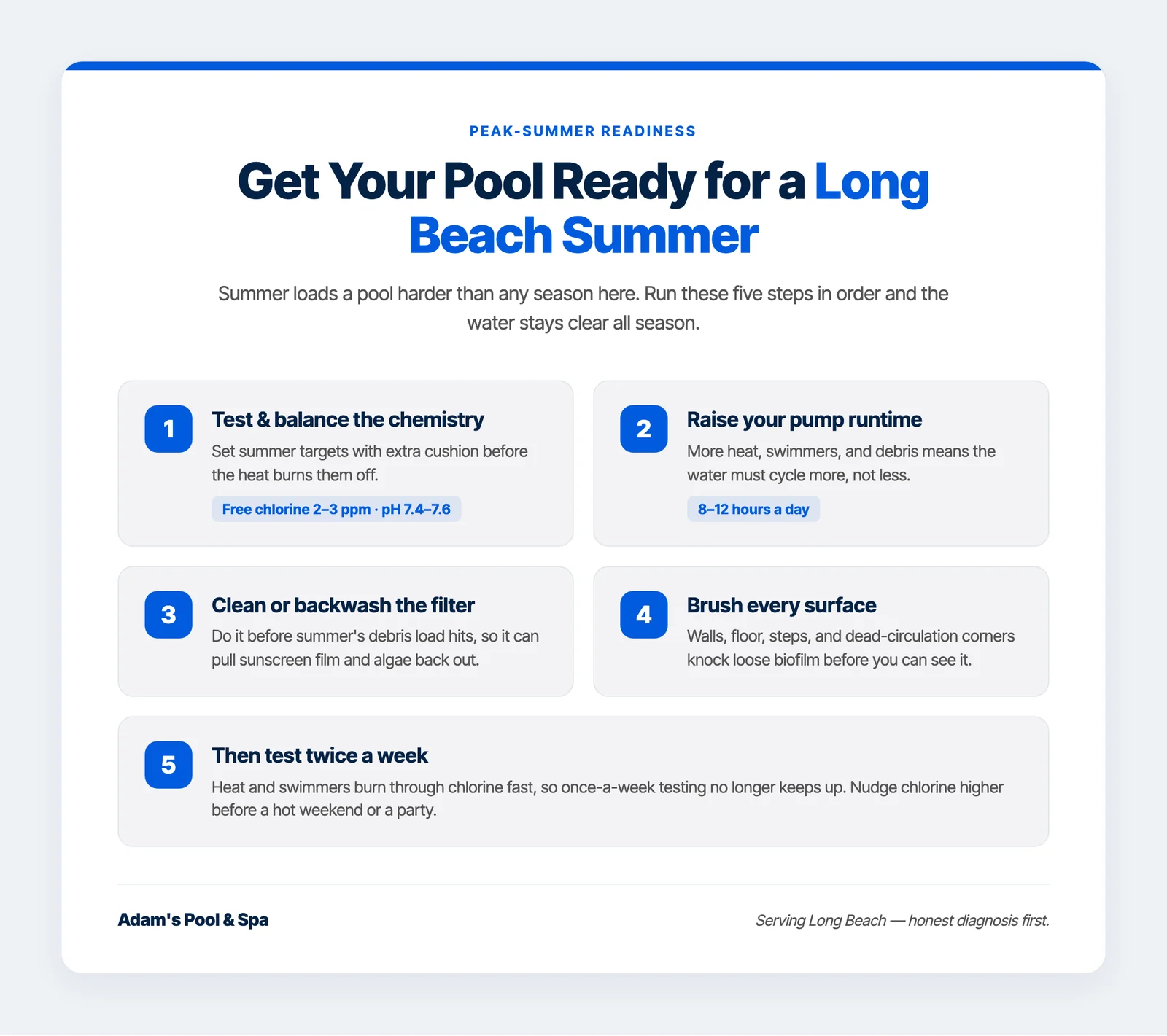
Getting your pool ready for a Long Beach summer comes down to five things: balancing the chemistry with extra cushion, raising your pump runtime, cleaning the filter, brushing every surface, and then testing more often once the heat and the swimmers arrive. Summer loads a pool harder than any other season here, so prep that would hold in April falls apart in July. Do it in order and the water stays clear all season. If you'd rather hand it off, residential pool cleaning in Long Beach gets your pool dialed in and keeps the chemistry steady through the heaviest months.
I'm Adam, and I've been cleaning Long Beach pools for about fifteen years. The call I get most in June is some version of "the pool looked fine last week, and now it's going." That's summer doing what summer does here: heat, more people in the water, and chemistry that burns through fast. This guide is about getting a pool ready for that peak-use stretch, not the spring opening. If your pool has been closed or sitting dormant, open it first, then come back to this checklist.
How do I get my pool ready for summer?
Start by testing the water and balancing it with more cushion than you'd carry the rest of the year. Free chlorine wants to sit at a steady 2 to 3 ppm in summer, pH at 7.4 to 7.6, and your cyanuric acid needs to be in range so the sun doesn't destroy your chlorine by lunch. Once the numbers are right, raise your runtime and clean the filter so the balanced water actually circulates.
The reason summer needs its own prep is load. A pool that gets used twice a week in spring might get used twice a day in July, and every swimmer brings in sweat, sunscreen, and organics that eat chlorine. Add coastal heat and long sun hours and you get a pool that's fighting harder to stay clear. The fix isn't exotic. It's the same fundamentals, run a step harder, in the right order.
If you're coming out of a dormant season, this isn't the whole story. Opening a pool that's been shut down has its own steps, from removing the cover to reconnecting equipment. Our seasonal pool care calendar walks through opening and the full year; this post picks up where opening leaves off and gets you through the hard part of summer.
Balance the chemistry for a summer that burns it off fast
Summer chemistry is the same chemistry, just under more pressure. The targets shift a little and the testing gets more frequent, because heat and swimmers pull the numbers around far faster than they do in cooler months.
Here's where I set a Long Beach pool for peak season:
- Free chlorine: 2 to 3 ppm. A notch above the cooler-season floor. This is your buffer against a hot weekend eating it to zero.
- pH: 7.4 to 7.6. High pH quietly neutralizes your chlorine, so a pool that reads "enough" chlorine can still cloud if pH drifts up.
- Total alkalinity: 80 to 120 ppm. This keeps pH from bouncing around every time it rains or you add chemicals.
- Cyanuric acid: 30 to 50 ppm. Stabilizer is chlorine's sunscreen. Too low and UV burns your chlorine off by noon; too high and it locks the chlorine out.
- Calcium hardness: 200 to 400 ppm. Coastal fill water runs mineral-heavy, so check it before it stains or scales.
Cyanuric acid is the one summer setting most homeowners miss. In our sun, unstabilized chlorine is basically gone within a few hours, which is why a pool can test fine in the morning and be defenseless by dinner. Our pool chlorine levels guide covers the targets and why they move in the heat.
One safety note that matters more once you're adding chemicals in a hurry: never mix pool chemicals together, always add chemical to water and not the other way around, and store everything ventilated and out of the sun. Summer is when people rush this and get hurt.
Raise your pump runtime for the heat
Your pump probably needs to run longer in summer than any calendar or manual suggests. The baseline rule is one full water turnover a day, but that baseline was written for a pool that isn't getting hammered. Heat, more swimmers, and more debris all mean the water has to cycle more to stay ahead of algae.
Most residential pools here want 8 to 12 hours a day through summer, up from the 6 to 8 that carries a pool in spring. Run the pump through the hottest part of the day, when algae pressure peaks and the water most needs to be moving. If you've got a variable-speed pump, a long low-speed run is quieter, cheaper, and clears better than a short high-speed blast.
Runtime is the step people cut to save on the power bill, and it's the step that costs them a green pool. Filtration, not chemistry, is what physically removes the junk from your water. Balanced chemistry with a pump that only runs four hours is a pool that clouds by August.
Clean the filter and brush before the season loads up
A filter that limped through winter will choke under summer's debris load, so clean or backwash it before the heavy use starts, not after it clogs. A filter running near capacity can't pull sunscreen film and dead algae back out of the water, and that's exactly what summer throws at it in volume.
Then brush every surface: walls, floor, steps, behind the ladder, around the light and the corners where circulation is weakest. Brushing knocks loose the early biofilm that algae builds on before you can see it, and it's the cheapest, most-skipped step in the whole routine.
A maintenance shock at the start of heavy-use season is worth it too. It burns off the combined chlorine and organic load that build up once the pool gets used daily, the stuff that makes water smell strong and sting eyes. Add it at dusk so the sun doesn't waste it, and run the pump overnight after.
The Long Beach angle: why summer is harder on our pools
A few things about pools here make summer prep more demanding than the manufacturer charts assume, and they're all local.
Our swim season basically never ends, so a pool goes into summer already tired instead of rested from a real winter shutdown. Coastal heat and long sun hours burn stabilized chlorine fast and unstabilized chlorine almost instantly, which is why cyanuric acid management does more work here than inland. And our fill water runs mineral-heavy near the coast, so calcium and scale pressure climb right when evaporation is concentrating everything in the pool.
Summer storms are the sneaky one. A quick rain dilutes your chlorine and stabilizer and washes deck and landscape organics into the water, and a balanced pool can cloud within a day if nobody rebalances after. The move isn't to drain, it's to test and shock promptly once the rain stops. The through-line is that our climate keeps chemistry moving fast, which is exactly why weekly maintenance prevents most summer problems before they start.
When should I call a pro to get my pool ready?
Call a professional when the numbers won't hold no matter what you add, when equipment is making new noises or losing pressure, or when summer prep is turning into a second job you didn't sign up for. Those are the cases where guessing gets expensive fast, because summer punishes a neglected pool quicker than any other season.
Be honest with yourself about your situation, too. If you travel, host often, or have a heavy-use pool with a lot of swimmers, the odds of a mid-summer green-out go up, and a pro keeping the chemistry steady is usually cheaper than the green-to-clean it prevents. Adam's Pool & Spa runs summer-prep and weekly service across Long Beach and LA County, and our residential pool cleaning and chemical balancing keep pools swim-ready through the hardest months. We don't publish flat pricing, because it depends on your pool's size, equipment, and condition. You get the real number after we've seen the pool, not before.
The questions Long Beach pool owners ask us most when they're getting a pool ready for a hard summer, answered plainly.
Ready for summer? Let's get it dialed in
You shouldn't have to guess whether your pool can take a full Long Beach summer, because the wrong guess turns into a green pool during the weeks you most want to swim. If you'd rather have it prepped and held steady, residential pool cleaning from Adam's Pool & Spa balances the water honestly for peak-use season and keeps it that way. We serve Long Beach and the surrounding neighborhoods, we're Jandy Certified and a Pentair Expert Installer, and we back our work with a twenty-four hour callback guarantee. Call us and we'll get your pool ready before the heat does the deciding for you.
Adam is the founder, owner, and lead technician of Adam's Pool & Spa, serving Long Beach and surrounding LA County for about fifteen years. He is Jandy Certified and a Pentair Expert Installer, and he built the business on education-first, anti-pressure service, including the "Pool School" session every new client gets.